Bridges, Culverts and ATV Crossings
There's nothing quite like the feeling of cruising down a beautiful Maine ATV trail, the sun dappling through the trees, the smell of pine in the air. But then, you hit a water crossing. Maybe it’s a rushing stream, a muddy bog, or a sturdy wooden bridge. Suddenly, that feeling of carefree adventure can turn to uncertainty. Is this crossing safe? Is it even legal? What are the rules here in Maine? It’s a common frustration for riders, and often, the answers aren't as clear as we'd like. This guide is here to unravel the complexities of navigating bridges, culverts, and other water crossings on your Maine ATV or UTV, ensuring you stay safe, legal, and respectful of our beautiful natural environment.
Understanding Maine's Rules for ATV Water Crossings
When you're out on the trails, especially in Maine where our network often weaves through diverse terrain, encountering water features is inevitable. From small trickles to wider streams, and the structures built to cross them, it's crucial to understand the "why" behind the rules. These aren't just arbitrary guidelines; they're in place to protect riders, the environment, and the very trails we love.
The "Why" Behind the Regulations
Think about the sheer power of water. Even a small stream, especially after a heavy rain or during spring melt, can cause significant erosion. This erosion can destabilize trail surfaces, wash away vital topsoil, and pollute sensitive waterways. When ATVs and UTVs cross undesignated areas, they can churn up stream beds, spread invasive species, and introduce sediment and fuel into fragile aquatic ecosystems. Maine's regulations, often championed by local clubs and the Bureau of Parks and Lands, aim to prevent this kind of environmental damage. They also protect the infrastructure itself; bridges and culverts are costly to build and maintain. Overloading a bridge, or damaging a culvert by riding through an improperly installed or maintained one, puts everyone at risk and can lead to trail closures. Ultimately, these rules are about ensuring that we can all continue to enjoy Maine’s vast trail network for years to come without causing irreparable harm. It’s a shared responsibility to keep our trails sustainable.
Official Definitions: Bridges, Culverts, and Designated Crossings
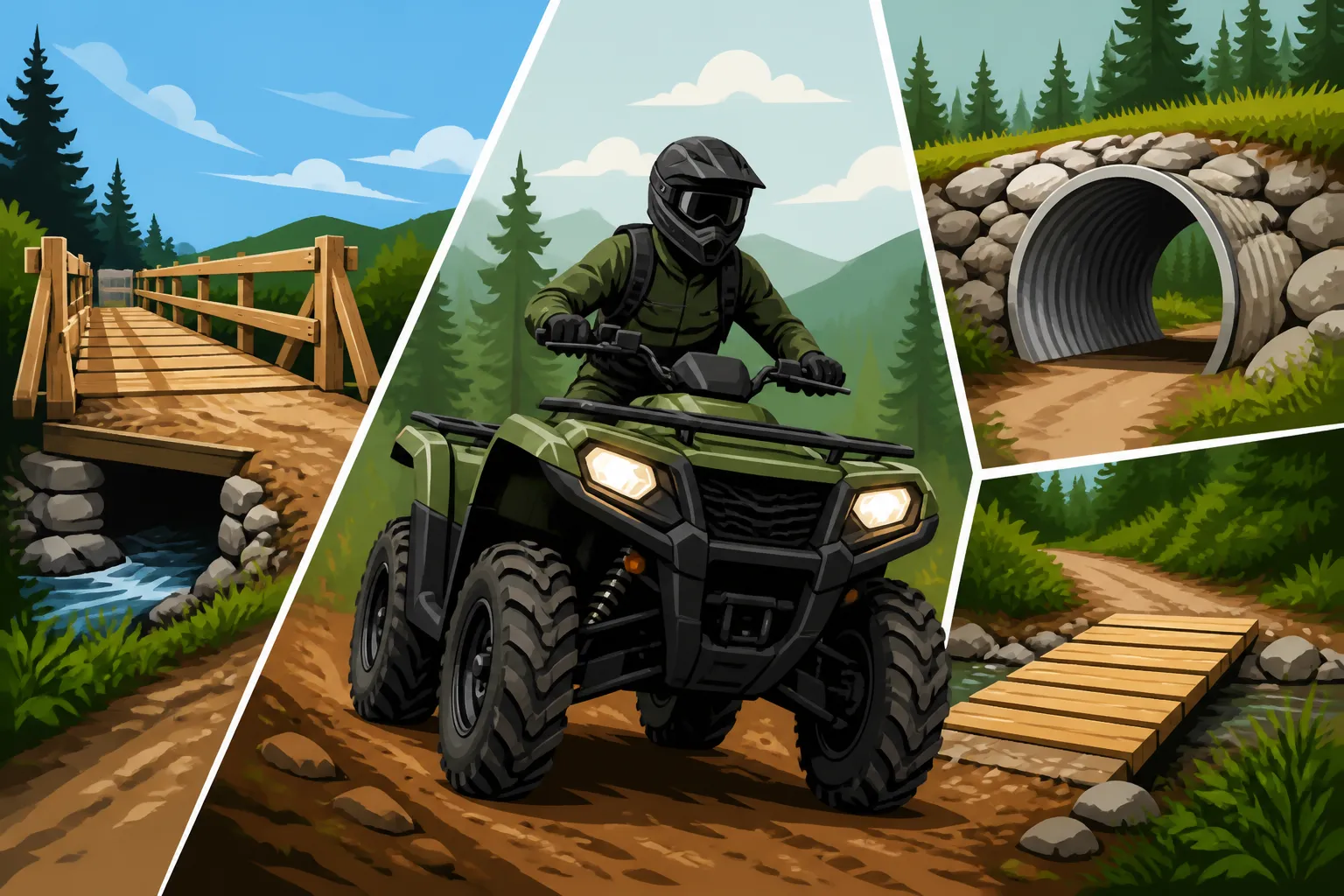
In Maine, the way we define these water-crossing structures directly impacts how you're legally allowed to interact with them. A bridge is generally a structure that carries the trail over a significant water body, ravine, or other obstacle. These are typically built with engineered components, designed for specific loads, and often have a deck for vehicles to drive across. They might be made of wood, steel, or a combination of materials. A culvert, on the other hand, is a tunnel-like structure that allows water to flow under a trail or road. They're often made of corrugated metal or plastic pipe, sometimes concrete, and are buried beneath the trail surface. The trail then passes over the culvert.
The key term here is "designated crossing." This means the crossing point, whether a bridge or a culvert, has been formally approved and maintained by the trail managing authority – usually a local ATV club in conjunction with landowners or the state. You’ll often see these marked clearly on [Maine ATV Trail Maps and Club Boundaries] or with signage on the trail itself. An informal or undesignated crossing is essentially riding directly through a stream or wet area where no specific structure or official route has been established. Maine law generally requires riders to stay on marked trails, and this extends to how you cross water. Creating your own path through a stream is almost always prohibited and can lead to significant environmental damage and potential fines.
Navigating Bridges on Maine ATV Trails
Bridges are a common sight on Maine's extensive trail system, ranging from simple wooden spans over small brooks to more robust structures crossing wider rivers. While they offer a clear path over water, they also require specific attention from ATV and UTV riders to ensure safety and preserve the trail infrastructure.
Bridge Construction and Weight Limits
Maine's ATV trails feature a variety of bridges, each with its own characteristics and limitations. You'll encounter everything from rustic log bridges, often built by volunteers from [Maine ATV Clubs and the Trails They Keep Open], to more modern structures made of treated lumber, steel, or even repurposed railroad cars. Many multi-use trails, particularly old rail beds, might have large steel bridges designed for trains, which are incredibly robust. However, many bridges are specifically designed for the weight of ATVs and snowmobiles. The crucial thing to remember is that not all bridges are built to withstand the same load.
Larger UTVs, especially those loaded with gear or multiple passengers, can weigh significantly more than a standard ATV. It's imperative to pay attention to any posted weight limits on bridges. These limits are there for a reason – exceeding them can weaken the bridge structure, causing damage or even collapse, putting you and others at serious risk. If a bridge seems questionable, or if you're unsure about its capacity relative to your machine, it's always best to err on the side of caution. Some bridges, particularly older ones, might also be narrower than ideal for wider side-by-sides. Navigating these can be tricky, and riders of wider machines need to be extra vigilant. For more on this, check out [Wide Side-by-Sides on Narrow Maine Trails].
Safe Practices for Crossing Bridges
Crossing a bridge on an ATV or UTV might seem straightforward, but a few simple practices can make all the difference in terms of safety.
- Approach Slowly and Assess: As you approach a bridge, reduce your speed. Look for any warning signs, posted weight limits, or specific instructions. Observe the condition of the bridge deck – are there loose planks, exposed nails, gaps, ice, or excessive mud? A quick visual scan can reveal potential hazards.
- Single File: If you're riding in a group, always cross bridges in single file. This distributes the weight more evenly and prevents multiple machines from jostling simultaneously on the structure. Allow ample space between riders.
- Maintain Control and Stability: Keep your speed low and consistent across the bridge. Avoid sudden braking, acceleration, or sharp turns, as these can disrupt your balance and the stability of your machine, especially if the surface is uneven or slippery.
- Hands on the Bars: Keep both hands firmly on the handlebars and your feet securely on the footrests. This ensures you maintain full control and are prepared for any unexpected movements or hazards.
- Look Ahead: Focus your gaze on the exit of the bridge and beyond, not directly at your front tire. This helps you maintain a straight line and anticipate any trail conditions immediately after the bridge.
- Yield to Others: If there's an oncoming machine and the bridge is only wide enough for one, the general rule of thumb is for one party to yield. Often, the machine that arrived first or has a clearer path will proceed, while the other waits patiently. Common courtesy goes a long way.
Remember, bridges are vital connectors on our trails. Treating them with respect by following safe crossing practices ensures they remain safe and open for all riders.
Dealing with Culverts and Stream Crossings
Beyond dedicated bridges, you'll frequently encounter culverts and opportunities to ford streams on Maine's trail system. These crossings present their own set of challenges and require a keen eye for safety and legality.
Identifying Safe Culvert Crossings
Culverts are the unsung heroes of trail drainage, allowing water to pass beneath the trail without eroding the surface. A safe culvert crossing is typically well-maintained, with the culvert pipe itself fully buried and stable, and the trail surface over it firm and level. You won't see exposed pipe edges that could catch a tire, nor will there be deep washouts immediately before or after the culvert. Often, a properly installed culvert will have some rock or other stabilization at its inlet and outlet to prevent erosion.
The problem arises with makeshift or damaged culverts. You might come across a trail that has a pipe simply laid in a ditch, half-exposed, or one where the fill material has completely washed away, leaving a gaping hole. These are not safe. Riding over an exposed or damaged culvert can cause serious machine damage, throw you from your vehicle, or even create a new, larger washout. It’s important to remember that creating your own "culvert" by driving repeatedly through a wet area, even if it seems shallow, can quickly lead to trail damage and environmental issues. When you see what looks like a culvert, take a moment to assess its condition. If it looks compromised, it’s far better to turn around or find an alternate route than to risk an accident or cause further damage. [Maine ATV Trail Fund and Club Grants] often go towards maintaining and repairing these crucial structures.
Techniques for Fording Streams and Brooks
While bridges and culverts are the preferred and often only legal method for crossing water on designated trails, there are specific, designated stream fording locations where crossing directly through the water is permitted. This is very different from simply driving into any stream you encounter.
When approaching a designated fording point:
- Stop and Assess: Before entering the water, stop your machine and get off to assess the crossing on foot if possible and safe to do so. Look at the water depth, current, and the composition of the stream bed. Are there large rocks, submerged logs, or deep holes? Is the water moving too fast? If you're unfamiliar with the crossing, observe other riders or consult your [Maine ATV Trail Maps and Club Boundaries] for any warnings.
- Look for an Entry and Exit Point: Identify the clearest, most stable entry and exit points. Avoid steep banks or areas with loose soil that could cause you to lose traction.
- Engage 4WD (if applicable): If your machine has it, engage four-wheel drive. This provides maximum traction and helps prevent getting stuck.
- Enter Slowly and Steadily: Drive into the water at a slow, consistent speed. Avoid splashing aggressively, as this can create a "bow wave" that washes over your engine or intake, potentially stalling your machine. Maintain a steady throttle.
- Keep Your Feet on the Footpegs/Floorboards: Do not put your feet down into the water. If you hit a submerged obstacle, your foot could get caught or injured.
- Maintain Momentum (but don't race): While you want to keep moving, don't speed through. A slow, steady pace creates the least disturbance and maintains control. You want just enough momentum to overcome any resistance from the water and keep moving forward.
- Watch Your Exhaust and Intake: Be mindful of your machine’s exhaust and air intake. On many ATVs and UTVs, these are positioned such that deeper water can cause issues. If you hear your engine sputter or feel it losing power, back off the throttle slightly and try to maintain forward motion.
- Exit Carefully: Once you reach the other side, slowly drive out of the water. Take a moment to clear your brakes by riding them lightly for a short distance to dry them out, especially if they are drum brakes or if you have any water ingress into disc calipers.
Remember, designated fording points are often found on trails maintained by clubs specifically for this purpose. If it's not clearly marked or appears risky, it's always best to turn back. For further tips, refer to [Fording a Stream on a Trail Ride].
Legal and Environmental Considerations
Riding ATVs and UTVs in Maine comes with a great deal of freedom, thanks to our extensive trail network. However, that freedom is contingent upon respecting the laws and the environment. When it comes to water crossings, these considerations are paramount.
Prohibited Crossings and Environmental Impact
Maine has clear regulations about where and how you can ride off-highway vehicles, and these rules are particularly strict around water bodies. It is generally prohibited to ride an ATV or UTV directly in streams, rivers, ponds, or wetlands unless on a specifically designated trail crossing (like a bridge, culvert, or approved ford) or on your own private land with proper environmental safeguards in place. The reasons for these prohibitions are deeply rooted in environmental protection.
Driving through unapproved water crossings can:
- Erosion and Sedimentation: Vehicle tires can churn up streambeds and banks, leading to increased erosion and sedimentation. This sediment can smother aquatic insect habitats, disrupt fish spawning grounds, and reduce water clarity, affecting the entire ecosystem.
- Pollution: ATVs and UTVs, like any motorized vehicle, can leak fluids such as oil, gas, and hydraulic fluid. These pollutants are toxic to aquatic life and can contaminate drinking water sources.
- Habitat Destruction: Sensitive riparian zones (areas along waterways) are critical habitats for many species of plants and animals. Riding through these areas destroys vegetation, disrupts nesting sites, and can crush small animals.
- Spread of Invasive Species: Mud and plant fragments can cling to your machine. When you cross water or travel from one area to another, you can inadvertently transport invasive plants, algae, and even microscopic organisms, introducing them to new, vulnerable ecosystems.
The penalties for illegal crossings can range from fines to more severe consequences, especially if significant environmental damage occurs. It's not just about the monetary cost; it's about preserving Maine's natural beauty for everyone. Stick to the marked trails, and if you're ever in doubt, assume it's a prohibited crossing. Consider your impact with every turn of the wheel.
The Role of Trail Clubs and Landowners in Maintaining Crossings
The vast majority of Maine's ATV trails, including their bridges and culverts, exist thanks to the incredible generosity of private landowners and the tireless efforts of local ATV clubs. These clubs, comprised of dedicated volunteers, are the backbone of our trail system. They negotiate land-use agreements, raise funds, and physically build and maintain thousands of miles of trails, including all the intricate water crossing structures.
Imagine the work involved: assessing streams for proper culvert placement, hauling materials to remote locations, constructing sturdy bridges that can withstand Maine's harsh winters and spring thaws. This isn't trivial work; it requires significant planning, labor, and resources. When you ride responsibly, stay on marked trails, and use designated crossings, you are showing respect for the landowners who open their property and for the volunteers who devote countless hours to building and maintaining these trails. [Maine ATV Club Membership and Dues] directly support this work, and many clubs also participate in the [Maine ATV Trail Grant Program] which helps fund larger infrastructure projects. Reporting damage to a bridge or culvert (as discussed below) is another way to contribute to their efforts, helping them prioritize repairs and keep the trails safe and open.
What to Do If a Crossing is Damaged or Unsafe
It's a beautiful day, you're enjoying your ride, and suddenly you encounter a problem: a bridge with missing planks, a culvert washed out, or a stream ford that looks far more treacherous than you remember. What's your next move?
Reporting Issues on Club Trails
If you come across a damaged or unsafe crossing on a Maine ATV trail, the absolute best thing you can do is report it. This not only helps get the issue fixed but also prevents other riders from potentially encountering the same hazard. Most ATV trails in Maine are maintained by local clubs, and they are your primary point of contact for such issues.
Here’s how to make an effective report:
- Safety First: Do not attempt to fix or cross a clearly unsafe structure. Your safety is paramount. If you're in a group, ensure everyone understands the hazard.
- Gather Information: Take detailed notes or photos.
- Location: Be as specific as possible. What trail are you on? What's the nearest landmark (road crossing, intersection with another trail, GPS coordinates if you have them)? Many riders use apps like onX Offroad, which can pinpoint exact locations. Mentioning something like "the wooden bridge about 2 miles north of the [Trailhead Parking That Fits a Trailer] in Johnsonville" is much more helpful than "a broken bridge somewhere."
- Type of Damage: Is it a missing plank, a complete washout of a culvert, a sag in a bridge, a rotten support beam, or significant erosion around the structure?
- Severity: How bad is it? Is it impassable for all machines, or just a minor hazard?
- Date and Time: Note when you observed the damage.
- Identify the Responsible Club: Most trails are signed, indicating which club maintains that section. If you're unsure, consulting a trail map or the [ATV Maine Club Map Online] can help you identify the correct club.
- Contact the Club: Reach out to the club via their website, social media page, or published contact information. Many clubs have a "Report a Trail Problem" section on their websites. Provide all the details you collected. If you can't find specific club contact info, you can also report to ATV Maine (the statewide association) or the Maine Bureau of Parks and Lands, who can often relay the message. [Reporting a Downed Tree on a Trail] follows a similar process.
Remember, these clubs are often run by volunteers. A detailed, polite report helps them immensely in addressing the problem efficiently.
Alternative Routes and Turning Back
It's tempting to try and push through, to find a workaround, or to simply ignore a damaged crossing. But sometimes, the safest and most responsible action is to turn back. This is where good planning and carrying the right navigation tools come into play.
- Assess the Risk vs. Reward: Is the damaged crossing truly impassable? Is there a safe, legal way around it? Attempting to create your own detour, especially through sensitive areas like wetlands or private property, is almost always illegal and highly destructive.
- Consult Your Maps: This is why carrying a good trail map, either paper or digital (like on a GPS device or smartphone app), is crucial. Can you identify an alternative trail that bypasses the damaged section? Is there a safe road-crossing option nearby (remembering Maine's 500-yard limit on public ways and [Maine ATV Road Rules for Young Riders])?
- Don't Push It: If you're unsure, or if the alternative route seems too long, too challenging, or too risky, swallow your pride and turn around. Getting stuck, damaging your machine, or causing an accident is far worse than having to retrace your steps or end your ride early.
- Communicate in Groups: If riding with others, make a group decision. Never leave someone behind or pressure them into taking an unsafe risk.
- Be Prepared: This scenario highlights the importance of being self-sufficient. Having extra fuel, a basic tool kit, and emergency supplies means you're better equipped if turning back lengthens your journey unexpectedly.
Ultimately, knowing when to say "no" to a crossing is a hallmark of an experienced and responsible rider. Maine's trails will always be there for you to explore another day.
Gear and Machine Considerations for Water Crossings
While proper riding technique and understanding the rules are paramount, having the right gear and ensuring your machine is up to snuff can also play a significant role in safe water crossings.
Essential Gear for Safe Water Crossings
When preparing for a ride that might involve water crossings, think about both your personal safety and your machine's capability.
- Personal Protection: Always wear appropriate riding gear, including a helmet (mandatory for riders under 18 in Maine, but smart for all), eye protection, sturdy boots, gloves, and long pants/sleeves. If you anticipate deep water, waterproof outerwear is a game-changer for your comfort.
- Recovery Gear: A winch is incredibly valuable, especially for UTVs or larger ATVs, should you get stuck in mud or a tricky culvert approach. Recovery straps, a shovel, and even a small hand saw can also be lifesavers. Brands like SuperATV offer a wide range of recovery gear, winches, and durable aftermarket parts designed to withstand rugged trail conditions, including those involving water and mud.
- Waterproof Storage: Have a waterproof bag or container for your phone, wallet, maps, and any essential documents like your [Maine ATV Registration Confirmation for Immediate Riding] or safety course certificate.
- Navigation Tools: As mentioned, a GPS device or a reliable mapping app on your phone (with downloaded offline maps) is crucial for identifying alternative routes if a crossing is impassable.
- Communication: While cell service can be spotty in Maine's backcountry, a fully charged phone is still important. Consider a satellite messenger for truly remote areas where traditional communication might fail.
It’s important to clarify that "snorkel kits" which raise engine air intakes and exhaust pipes are typically for extreme mud or deep-water play, not usually necessary for legal, designated trail crossings. Modifying your machine for extreme water fording can also impact its handling and potentially void warranties, and it's generally discouraged for typical trail riding due. Focus on gear that promotes safety and responsible recovery.
Machine Maintenance After Water Exposure
Water and mechanical components aren't always the best of friends. After a ride that involves significant water crossings, a little preventative maintenance can save you a lot of headaches and expense down the road.
- Clean Your Machine: First things first, wash off all the mud and debris. Pay close attention to the suspension components, brakes, and cooling system. Mud left to dry can trap moisture, promote rust, and hide damage.
- Check Fluids: Water can contaminate engine oil, transmission fluid, and differential fluid. If you notice a milky or cloudy appearance in any of these, it means water has entered, and the fluid needs to be changed immediately. Water significantly reduces lubrication effectiveness, leading to premature wear.
- Inspect Brakes: Water can reduce braking performance and accelerate wear. Ride your brakes lightly for a short distance after a crossing to help them dry. After your ride, check brake pads for excessive wear and ensure calipers are free of debris.
- Grease Fittings: Many ATVs and UTVs have grease zerks on suspension components, drive shafts, and steering linkage. After a wet ride, force fresh grease through these fittings to push out any trapped water and grit. This is a simple step that greatly extends component life.
- Inspect Bearings: Wheel bearings and swingarm bearings are particularly vulnerable to water ingress. Listen for new noises, feel for play in the wheels, and consider re-greasing or replacing seals if you suspect water damage. SuperATV offers heavy-duty bearings and seals that can provide better protection against water and mud than stock components.
- Electrical Connections: Water can wreak havoc on electrical systems. While modern machines are increasingly sealed, it's a good idea to check major electrical connections for corrosion or signs of water intrusion, especially if you experience any electrical gremlins. A dielectric grease can help protect connections.
- Air Filter: If your air filter got wet, it needs to be thoroughly dried or replaced. A wet air filter can restrict airflow and, worse, allow dirt and debris to bypass the filter and enter your engine, causing severe damage.
- Rust Prevention: Pay attention to exposed metal components, especially bolts, exhaust systems, and frame areas. A quick spray with a rust-inhibiting lubricant can make a big difference, especially for machines stored in damp conditions.
By taking these steps, you not only ensure your ATV or UTV remains reliable but also protect your investment, allowing you to enjoy many more miles on Maine's beautiful trails.
Disclaimer
This article is for general informational purposes only and does not constitute professional advice. Laws, prices and regulations vary by location and change over time. Consult a qualified professional for guidance on your specific situation.