Riding the Extreme Right of a Maine Road
Navigating Maine's vast network of trails and roads on your ATV or UTV can be an incredible experience, but it also comes with its own set of rules and sometimes confusing regulations. One area that often trips up riders is understanding exactly how and where you can operate your machine on public roads, especially the nuanced directive to ride on the "extreme right." This guide aims to clear up that confusion, offering practical advice and insights so you can ride safely and legally, without the constant worry of an unexpected encounter with a game warden.
Understanding Maine's "Extreme Right" Rule for ATVs
Let's be honest, the idea of riding your ATV or UTV on a public road can feel a bit counter-intuitive. These machines are built for trails, for dirt, for adventure off the beaten path. But Maine, with its unique trail system often linking towns and services, does allow for limited road access under specific conditions. The "extreme right" rule is one of those foundational principles that, when misunderstood, can lead to trouble. It's not just a suggestion; it's a legal requirement designed to keep you, and everyone else on the road, safe.
The Letter of the Law: What "Extreme Right" Means
When Maine law talks about riding on the "extreme right" of a public way, it's pretty literal. It means staying as far to the right as safely possible. This isn't about claiming an entire lane; it's about minimizing your footprint on the road and allowing other traffic ample room to pass. For ATVs and UTVs, this often means riding on the shoulder, if one exists and is safe to use. If there's no shoulder, or if the shoulder is too narrow or hazardous (think deep gravel, potholes, or steep drop-offs), then you're expected to hug the right-hand edge of the paved or maintained travel lane. The key here is "safely possible"—you're not expected to put yourself in danger to avoid a tiny fraction of the road.
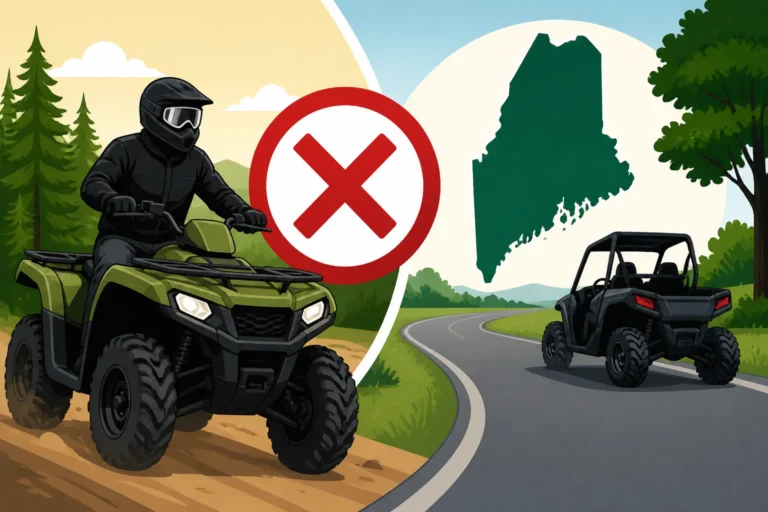
It's a common misconception that "extreme right" gives you free rein to cruise down any road. That's simply not true. This rule primarily applies to situations where ATVs are permitted on a public way, such as designated [Maine ATV-Access Routes and How Towns Post Them], or when crossing a public way, or within the specific 500-yard limit allowed in certain scenarios. You're not supposed to be riding major highways or interstates, no matter how far to the right you go. Always remember that the burden is on you, the ATV operator, to know where you are allowed to ride and to do so responsibly.
Why This Rule Exists: Safety and Coexistence
Maine's "extreme right" rule isn't just arbitrary bureaucracy; it's rooted deeply in safety and the need for all users to coexist on our shared infrastructure. ATVs and UTVs, while incredibly fun, aren't designed for highway speeds and lack many of the safety features of traditional automobiles. They're also much less visible. By requiring riders to keep to the extreme right, the law aims to:
- Enhance Visibility: Keeping to the right makes you more predictable and easier for other motorists to see, especially when they're approaching from behind or pulling out from side roads. This is crucial for preventing collisions.
- Facilitate Traffic Flow: By staying out of the primary travel lanes as much as possible, you allow cars and trucks to maintain their speed and flow, reducing congestion and frustration. This smooths out interactions and makes it less likely for motorists to become impatient or make unsafe passing maneuvers.
- Reduce Risk of Collision: When vehicles occupy the same space, the risk of an accident dramatically increases. The "extreme right" rule creates a buffer, giving both ATV riders and motorists more space and reaction time. This is especially vital on narrow, winding Maine roads where visibility can be limited, or when you encounter large vehicles like logging trucks or RVs.
Ultimately, this rule is about shared responsibility. As ATV enthusiasts, we want to enjoy our machines without creating hazards for others. Adhering to the "extreme right" is a fundamental way to demonstrate that responsibility, helping to maintain public goodwill and preserve trail access for years to come.
Practical Application: Riding Your ATV on Maine Roads
So, you understand why the extreme right rule exists, but what does it really look like when you're actually out there, riding the trails that connect to a public way? It’s not just about staying far over; it’s about a mindful approach to road sharing, ensuring you’re visible, predictable, and fully prepared for the dynamics of mixed traffic.
Positioning Your Machine Safely
When you transition from a trail onto a public road, even a short section that's been designated an ATV access route, your riding posture and awareness need to shift gears. First and foremost, reduce your speed. Roads, even those with limited traffic, demand a different level of caution than an open trail. You’ll encounter blind spots, driveways, and unexpected obstacles like mailboxes or pedestrians.
Your goal is to maintain a straight, predictable path along the far right edge of the road or shoulder. Avoid weaving or sudden movements. If a safe, stable shoulder exists, utilize it. Sometimes these shoulders can be gravelly or uneven, so choose your line carefully to prevent losing control. If you must ride on the paved surface, keep your tires as close to the white line on the right (or the edge of the pavement) as you can without scraping your side-by-side's tires on a guard rail or hitting a deep ditch. Think about how a bicycle rider might position themselves in a similar situation – visible but unobtrusive. Always be prepared to yield to larger vehicles, and if necessary, pull over completely to allow traffic to pass safely. When you're approaching an intersection or a place where you'll be turning, make your intentions clear well in advance.
Essential Gear for Road Riding Safety
While Maine doesn't require a full suite of street-legal modifications for limited road use, certain accessories dramatically improve your safety and visibility when riding on the extreme right of a public way. Think of these as investments in your peace of mind and your safety.
- Lighting: Bright headlights and taillights are non-negotiable, especially during dawn, dusk, or overcast days. Many stock ATV lights are adequate for trails but can be dim on open roads compared to car headlights. Consider upgrading to brighter LED lights or adding auxiliary lights. For UTVs, having brake lights that activate reliably is crucial. [Maine Lighting Requirements for Night Riding] details specific standards for lights.
- Mirrors: Side mirrors are incredibly helpful for keeping an eye on traffic behind you without constantly turning your head. While not always legally mandated for ATVs in every road situation, they’re a common-sense safety addition. Products from brands like SuperATV offer robust mirror kits that are designed to withstand trail vibrations while providing clear visibility for road sections.
- Turn Signals: While hand signals are always an option and generally understood, proper turn signals on your machine eliminate ambiguity and allow you to keep both hands on the handlebars for better control. This is particularly useful in areas with higher traffic volume or where turns might be unexpected for motorists.
- Reflective Gear: Whether it’s reflective tape on your machine or reflective elements on your helmet and riding jacket, anything that makes you more visible, particularly at night or in low light, is a huge plus. Motorists expect cars and trucks; they don’t always expect an ATV on the roadside.
Equipping your machine with these safety enhancements goes a long way toward mitigating risks and ensuring you can confidently stick to the extreme right, knowing you’ve done everything to be seen and understood by other road users. It’s about proactive safety, not just reactive compliance.
Safety and Legal Considerations for Road Riding
Riding on Maine's public ways, even briefly, demands a heightened sense of responsibility. It's not just about knowing the "extreme right" rule; it's about understanding the broader legal framework and the potential consequences of non-compliance. Maine game wardens are dedicated to ensuring safety on and off the trails, and they take road rules seriously.
Penalties for Non-Compliance
Ignoring Maine's ATV road regulations can quickly turn an enjoyable ride into a costly and frustrating experience. Penalties for violations vary depending on the severity and nature of the offense, but they are designed to deter unsafe behavior. Riding an unregistered ATV on a public way, for example, is a clear violation, with fines that can certainly impact your wallet. You can find more specific details on potential fines in articles like [Penalties for Riding an Unregistered ATV in Maine]. Operating an ATV or UTV negligently, or in a way that endangers others, can lead to more severe penalties, including fines and potential suspension of your ATV registration privileges.
Beyond financial penalties, there’s the risk of accidents. When an ATV is involved in a collision with a motor vehicle on a public road, the ATV operator is often at a significant disadvantage, both physically and legally. Understanding and adhering to rules like the "extreme right" helps protect you from these scenarios, as it demonstrates due diligence in safe operation. Wardens frequently conduct [Maine Warden Service ATV Patrols] on and near public roads, specifically looking for violations that could compromise safety. Being knowledgeable and compliant is your best defense against citations and ensures a safer ride for everyone.
Insurance and Safety: Beyond the Letter of the Law
While Maine law doesn't always mandate ATV insurance for all riding scenarios, particularly on private land, the moment you venture onto a public road, even for a brief crossing or a designated access route, your liability risk changes dramatically. Most homeowners' insurance policies offer very limited, if any, coverage for ATV incidents, especially when operating on public ways. This means that if you're involved in an accident with another vehicle, you could be personally liable for significant damages, medical bills, and legal fees.
It’s highly advisable to carry a dedicated ATV or UTV insurance policy that includes liability coverage. This protects you financially in case you cause damage to property or injury to another person while operating your machine on a public way. While not directly related to the "extreme right" rule, adequate insurance offers a crucial layer of protection, allowing you to ride with greater peace of mind knowing you're covered for unforeseen circumstances.
Furthermore, consider taking a [Maine ATV Safety Course Requirements]. These courses, often available online or in person, provide invaluable education on safe riding practices, understanding regulations, and how to react in various situations, including interacting with road traffic. Even experienced riders can benefit from a refresher, as laws and best practices evolve. Safety courses not only make you a more informed rider but also contribute to a safer environment for everyone sharing Maine’s beautiful outdoor spaces.
Navigating Specific Road Scenarios in Maine
The "extreme right" rule isn't a one-size-fits-all solution for every road interaction. Maine's diverse landscape means you'll encounter everything from quiet dirt roads to bustling intersections. Knowing how the rule applies in different contexts, and what other regulations come into play, is key to a seamless and legal riding experience.
Designated ATV-Access Routes vs. General Public Ways
It's absolutely critical to distinguish between a designated ATV-access route and a general public way where ATVs are not explicitly permitted. Many towns in Maine have wisely embraced ATV tourism and have created specific [Maine ATV-Access Routes and How Towns Post Them]. These routes are marked with official signs indicating that ATV use is allowed, often connecting trails to local businesses or other trail systems. On these routes, the "extreme right" rule still applies, meaning you must stay as far to the right as safely possible, but you have the legal right to be there.
However, a general public way, without specific designation, is usually off-limits to ATVs, even if you ride on the extreme right. You cannot simply decide to take any public road because you're hugging the shoulder. It's essential to consult local ordinances and maps provided by ATV clubs or the state before planning your route. Riding on an undesignated road is considered trespass and can result in fines and the loss of access to trails in that area. When in doubt, assume a public road is closed to ATVs unless explicitly marked otherwise.
Crossing Highways and the 500-Yard Limit
One of the most common applications of the "extreme right" rule involves crossing public ways or utilizing the limited 500-yard allowance. Maine law permits ATVs to cross a public way, or travel along it for a distance not exceeding 500 yards, strictly for the purpose of gaining access to another trail or private land. This is where the "extreme right" becomes paramount. When performing such a maneuver, you must:
- Make a complete stop: Before entering or crossing any public way, you must stop your ATV or UTV completely.
- Yield to all traffic: This means waiting until the way is clear in both directions, ensuring no oncoming or approaching vehicles pose a hazard.
- Proceed quickly and directly: Once clear, cross or travel the 500 yards as directly as possible, maintaining your position on the extreme right. Do not meander or make unnecessary stops.
- Be hyper-vigilant: Roads are unpredictable. Watch for driveways, pedestrians, cyclists, and other vehicles. Your focus should be 100% on the road and surrounding environment.
The 500-yard limit is a critical detail. You cannot just ride for half a mile down a public road because you're on the shoulder. This limit is designed for short, necessary transitions. Exceeding it, even while adhering to the extreme right, makes you vulnerable to citations. Understanding [Maine's 500-Yard Limit on a Public Way] is essential for all riders. For larger UTVs, ensuring you have clear sightlines and using accessories like those from SuperATV that provide additional lighting and mirrors, can make these crossings significantly safer and less stressful. It's all about making quick, decisive, and safe movements to connect from one trail to the next.
| Requirement/Practice | Legal Mandate (Maine) | Recommended Best Practice |
|---|---|---|
| Positioning | Ride on the "extreme right" of the public way. | Stay on shoulder if safe; otherwise, far right of travel lane. |
| Speed | Must be reasonable and prudent. | Significantly reduce speed, be prepared to stop. |
| Stopping at Public Ways | Complete stop required before entering or crossing. | Always stop, look both ways multiple times. |
| Yielding | Yield to all vehicular traffic. | Assume vehicles don't see you; make yourself visible. |
| Turn Signals | Hand signals generally accepted. | Install and use mechanical turn signals. |
| Headlights/Taillights | Required during specified times (e.g., night, low visibility). | Use bright LEDs day and night for maximum visibility. |
| Mirrors | Not always legally mandated for ATVs on public ways. | Install side mirrors for awareness of rear traffic. |
| Registration | Valid Maine registration always required. | Carry physical proof of registration. |
| Insurance | Not always legally mandated for ATVs. | Carry liability insurance for all road use. |
| Helmet | Required for riders under 18; recommended for all. | Always wear a DOT-approved helmet. |
| Visibility Gear | Not specifically mandated for machines. | Wear bright, reflective clothing; add reflective tape to machine. |
Disclaimer
This article is for general informational purposes only and does not constitute professional advice. Laws, prices and regulations vary by location and change over time. Consult a qualified professional for guidance on your specific situation.