Purple Paint Marks Along a Maine Road
There’s nothing quite like the thrill of exploring Maine’s vast network of ATV and UTV trails, but sometimes, a simple splash of purple paint can bring your ride to an abrupt halt. This seemingly innocuous color, often found on trees or fence posts near a road, carries a significant legal weight in the Pine Tree State, causing confusion and frustration for many riders who just want to enjoy the outdoors. This guide will cut through the uncertainty, explaining exactly what purple paint marks mean in Maine, how they impact your riding, and what steps you need to take to avoid accidental trespass and ensure your adventures stay on the right side of the law.
The Legal Meaning of Purple Paint in Maine
Imagine you're cruising down a scenic dirt road, perhaps looking for that perfect trail connector you heard about, and you suddenly spot a line of purple paint marking trees along the edge of the woods. For many, it's a head-scratcher. Is it just a landowner's quirky decoration? Is it a hunting boundary? In Maine, purple paint is far more than that; it's a legally recognized "No Trespassing" sign, loud and clear, without a single word needing to be written.
"No Trespassing" Without the Words
Maine law specifically designates purple paint as an official marker for private property where entry is prohibited. The legislative intent behind this rule was actually quite practical: to provide landowners with a durable, easily recognizable, and cost-effective way to post their property against trespass. Unlike traditional "No Trespassing" signs that can fade, tear, be shot full of holes, or simply get stolen, a painted mark on a tree or post is much more resilient to the elements and vandalism. It's also visually distinct and, once you know what it means, unmistakable.
This means that any land marked with purple paint, whether it's a small patch of woods or a sprawling acreage, is explicitly off-limits unless you have direct, express permission from the landowner. It doesn't matter if you're on foot, riding a bicycle, hunting, or, most importantly for our purposes, operating an ATV or UTV. The moment your machine crosses that invisible line, you are committing trespass. This isn't a suggestion; it's a legal prohibition, and ignorance of the law is rarely an excuse when a warden rolls up. Maine respects the rights of its landowners, and this purple paint rule is a cornerstone of that protection.
Where You'll See Purple Paint Near Roads
Purple paint marks are particularly relevant for ATV and UTV riders because they are so often found precisely where riders are most likely to encounter ambiguous boundaries: alongside public and private roads, near trail entrances, or at the edges of what might appear to be open land. You'll typically find these marks on natural features like trees, prominent rocks, or on man-made structures like fence posts, utility poles, or even the occasional boundary marker stake. They are usually spaced at intervals that make the property line clear, often at corners, along straightaways, and wherever the boundary changes direction.
Picture this: you're driving your side-by-side down a gravel town road, adhering to [Maine's 500-Yard Limit on a Public Way] to connect to another trail section. You see what looks like an old logging road veering off into the woods, a perfect shortcut. But then you spot a series of trees just inside the perceived entrance, all marked with a bright splash of purple. This isn't a suggestion; it's a definitive barrier. That logging road, despite its appearance, is private, and the landowner has clearly communicated that it's not open for public use. It's often at these transition points – where a public road meets private land, or where a permitted trail might abruptly end and private property begins – that these purple markings are most crucial. They define the edge, making it abundantly clear where you can and cannot go, even if the terrain beyond looks inviting or appears to be a natural extension of public access.
Why This Matters for Maine ATV and UTV Riders
For those of us who love exploring Maine's vast wilderness on our ATVs and UTVs, understanding purple paint isn't just a nicety; it's absolutely critical for legal and responsible riding. Maine has a unique system where much of our beloved trail network relies on the generosity of private landowners, and respecting their property is paramount to keeping those trails open. Purple paint is a clear indicator that a specific landowner has decided to withdraw that permission.
Avoiding Accidental Trespass on Private Land
It's incredibly easy to make a wrong turn or misinterpret a property line when you're out on the trails, especially in areas where mapping might be less precise or where land ownership changes frequently. However, with purple paint, there's no room for misinterpretation. If you see it, you do not enter. Ignoring these marks, even accidentally, can lead to serious consequences. The primary risk is a charge of trespass, which in Maine, can carry fines. Beyond that, you could face demands for damage restitution if your machine causes any impact to the land, and in some cases, your ATV or UTV might even be impounded. More broadly, such incidents erode the trust between riders and landowners, potentially leading to further trail closures and a reduction in the overall riding opportunities we all cherish. [Maine Trespass Law for ATV Riders] is clear on this, and wardens take it seriously.
Think about it: many of Maine's extensive trails exist solely because landowners have granted [Landowner Permission on Maine ATV Trails]. When an area is marked with purple paint, it signifies a landowner who has explicitly said "no." This act effectively overrides any perceived or implied permission that might exist on other parts of the trail system. Even if you're rocking robust components from a brand like SuperATV that could tackle any terrain, you need to ensure that terrain is legal to ride on. It's about preserving the privilege of riding, not just avoiding a ticket.
ATV Road Rules and Purple Paint
Maine has specific rules about riding ATVs and UTVs on or alongside public roads, such as making a legal [Maine ATV Road Crossing at an Angle] or operating within 500 yards of a public way to access a trail. These rules are designed to facilitate access while ensuring safety. However, these rules do not grant you permission to enter private land adjacent to these roads, even if it's only for a few feet.
Here's a common scenario: you're legally riding the shoulder of a town road, looking for the marked trail connector. Suddenly, you need to stop for a moment, perhaps to check your map or let another rider catch up. If the land immediately beside the road is marked with purple paint, you cannot pull off the shoulder and onto that property, even for a brief pause. You cannot turn around on that land, nor can you use it as an access point to what you think might be a trail. The road rules pertain to the road itself and its designated right-of-way, not the private land abutting it. Many times, the legal right-of-way is much narrower than it appears, and private property begins very close to the paved or gravel surface. Encountering purple paint along a road means you must remain strictly on the public way or turn back if it blocks your intended route. Misinterpreting this can quickly turn a legal road maneuver into an illegal trespass, potentially leading to [Losing Trail Access After a Violation] if you get caught.
The Importance of Knowing Property Lines
Proactive knowledge is your best defense against unintended trespass. While purple paint serves as a vital last-minute warning, responsible riders should always strive to know where they are riding before they even hit the throttle. This means consulting official [Maine ATV Trail Maps and Club Boundaries] from sources like ATV Maine or local clubs, and utilizing GPS applications like onX Offroad or similar mapping tools to understand land ownership. These resources can often delineate private parcels and help you plan your route to avoid problematic areas altogether.
Understanding property lines isn't just about avoiding trouble; it's about being a good steward of the trails and a respectful visitor to Maine's landscape. A lot of hard work goes into maintaining [Landowner Relations on Maine ATV Trails], and one act of trespass can jeopardize an entire trail section for everyone. If you're using a side-by-side with aftermarket modifications, like those from SuperATV, you're likely investing in your machine's capability and longevity; extend that same investment to knowing your legal boundaries. When purple paint appears on a trail segment that used to be open, it often signals that a landowner has decided to close it, perhaps due to past abuses, liability concerns, or simply changing their mind. Being informed helps you respect those decisions and choose alternative, legally accessible routes.
What to Do When You Encounter Purple Paint
So, you're out on the trail or near a road, enjoying the crisp Maine air, and then you see it: that unmistakable splash of purple paint. What now? Your immediate actions are crucial, not just for your legal standing but for demonstrating responsible riding that benefits the entire ATV and UTV community.
Turn Back or Seek Alternate Routes
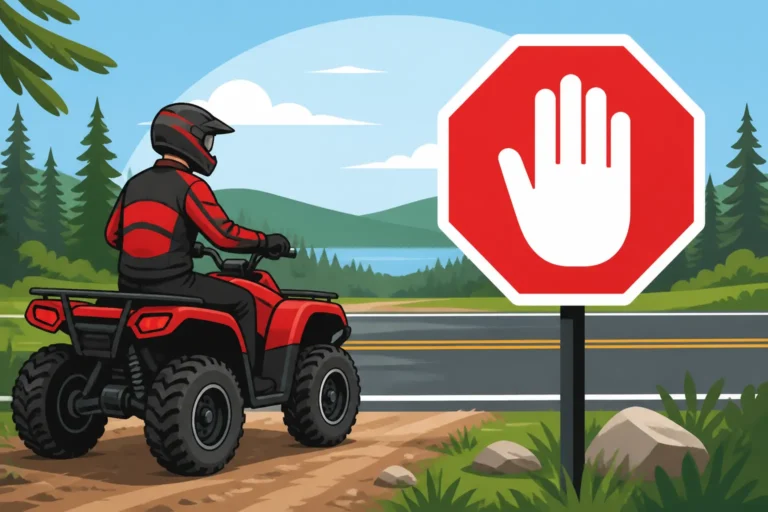
The first and most important rule when you see purple paint is simple: do not proceed. This is a hard stop. You must turn your machine around and find an alternative route. There is no grey area here. Even if the trail looks inviting, or if it appears to be only a short stretch of marked land before it opens up again, that purple paint unequivocally states "no entry." Continuing past it, even for a moment, constitutes trespass.
This might mean backtracking a considerable distance, or it could force you to rethink your entire day's ride. It can be frustrating, especially if you had a specific destination in mind. However, it's far better to be inconvenienced than to face legal penalties, potential fines, or worse, cause further damage to the precious [Landowner Relations on Maine ATV Trails] that are so vital to our sport. If you're equipped with robust winching gear or heavy-duty components from SuperATV, it might be tempting to power through, but legal boundaries always supersede mechanical capability. Respecting the "no trespassing" signal is non-negotiable.
Verifying Trail Access and Maps
A proactive approach can help you avoid these unwelcome surprises. Before you even load up your machine, make it a habit to check official sources for trail information and maps. Organizations like ATV Maine, the Maine Department of Agriculture, Conservation and Forestry (DACF), and local ATV clubs all publish maps and trail status updates. These resources are designed to show you where legal trails exist and often highlight areas where permission has been withdrawn or where private land abuts trails.
When you're [Checking Maine Trail Status Before You Drive], look for any alerts about specific trail closures or changes in access. If you have a GPS with up-to-date land ownership layers (many popular off-road mapping apps offer this feature), you can often see property boundaries directly on your screen. If a trail segment you intended to ride is now marked with purple paint, it's a clear indication that the map may be outdated or that the landowner has recently revoked permission. Always defer to the physical marking on the ground. This due diligence not only saves you from potential legal trouble but also helps you plan a more enjoyable, stress-free ride. Referencing [Maine ATV Trail Maps and Club Boundaries] is a vital step in this process.
Reporting Concerns to ATV Clubs or Wardens
If you encounter purple paint on a trail that you know has historically been open, or if the markings seem ambiguous or unclear (though they rarely are), it's a good idea to report your observation. The first point of contact should generally be the local ATV club responsible for that trail section. They are the ones who work directly with landowners, maintain the trails, and update their maps. Reporting a new purple-painted section allows them to investigate, communicate with the landowner, and update their trail information for other riders. This also helps the club understand where trail permissions may be shifting.
In cases where you witness someone actively trespassing on purple-painted land, or if you have concerns about illegal activity, you can also consider contacting the Maine Warden Service. While you might not want to [Reporting an ATV Trespass to the Warden Service] every time you see a painted tree, egregious violations or safety concerns warrant their attention. Remember, the wardens are there to enforce state laws, including trespass laws, and protecting private property rights is a significant part of their job. Understanding the implications of purple paint contributes to a safer, more sustainable riding future for everyone in Maine.
| Feature | Traditional "No Trespassing" Signs | Purple Paint Marks |
|---|---|---|
| Visibility | Typically a printed sign, text-based | Distinctive purple splash of paint |
| Durability | Susceptible to weather, vandalism | Highly durable, long-lasting |
| Interpretation | Requires reading the text | Visual, universally understood |
| Placement | On posts, trees, fences | On trees, rocks, fence posts |
| Legal Status | Legally recognized in Maine | Legally recognized in Maine |
| Clarity | Direct instruction | Clear, unambiguous visual warning |
| Cost | Varies by sign type and quantity | Generally lower, paint is readily available |
| Maintenance | Needs periodic replacement/checking | Less frequent maintenance needed |
Disclaimer
This article is for general informational purposes only and does not constitute professional advice. Laws, prices and regulations vary by location and change over time. Consult a qualified professional for guidance on your specific situation.