Complete Stop Before Entering a Maine Public Way
Navigating Maine's vast network of ATV trails is an incredible experience, but it’s crucial to understand the rules when those trails intersect with or briefly utilize public roads. One of the most fundamental, and often misunderstood, requirements for ATV riders in Maine is the absolute necessity to come to a complete stop before entering any public way. Failing to grasp this seemingly simple rule can lead to dangerous situations, hefty fines, and the potential loss of your riding privileges. This guide is here to break down exactly what this "complete stop" entails, why it’s so important for your safety and the safety of others, and how to confidently and legally transition between trail and road.
Understanding "Public Way" in Maine for ATV Riders
When we talk about "public ways" in Maine, many riders immediately picture bustling paved highways. While those certainly count, the definition is much broader and often catches people off guard. Understanding what truly constitutes a public way is the first step in riding legally and safely in the Pine Tree State.
Defining "Public Way" Beyond Just Paved Roads
In Maine, a "public way" isn't limited to the well-traveled asphalt roads that cars and trucks use daily. It encompasses a much wider range of areas, including paved state routes, town-maintained gravel roads, and even some dirt roads that might feel like private logging paths. The key distinction lies in who maintains the road and whether it's open for public travel, regardless of its surface condition or how frequently it's used by four-wheeled vehicles. For instance, that quiet, dusty lane connecting two sections of trail, which you might assume is just a private woods road, could very well be a town-maintained public way. If the town or state is responsible for its upkeep – clearing snow, grading it, or filling potholes – then it's a public way, and all the associated rules, including the complete stop, apply. This is a common point of confusion for riders, especially those exploring more remote areas where the lines between private and public land can seem blurry. Always assume a road is public unless you have clear, undeniable proof that it is private and you have explicit permission to be there.
Why This Distinction Matters for ATV Operators
This broad definition of a public way isn't just a legal technicality; it's a foundational aspect of ATV safety and responsibility. When you're on an ATV trail, you're typically dealing with other ATVs, dirt bikes, or perhaps pedestrians. The speeds are different, the expectations are different, and the potential for severe collision is generally lower. However, when you enter a public way, even a quiet dirt road, you're suddenly sharing space with much larger, heavier, and faster vehicles like cars, trucks, and even logging rigs. These vehicles have blind spots, they operate at higher speeds, and their drivers might not be actively looking for an ATV emerging from a wooded trail. The "public way" designation brings with it a whole new set of rules designed to protect everyone on the road, including you. Ignoring this distinction, perhaps thinking a gravel road is "just a trail connector," can lead to devastating accidents, serious injuries, and significant legal trouble. It’s about shared responsibility and ensuring everyone can use Maine's roads safely, whether they're in a car or on an ATV.
The "Complete Stop" Rule: What It Means and Why It's Critical
The instruction to make a "complete stop" before entering a public way might sound straightforward, but it's surprising how often riders misinterpret or rush this crucial step. It's more than just a momentary pause; it's a deliberate action designed to maximize safety.
Interpreting "Complete Stop" in a Real-World Scenario
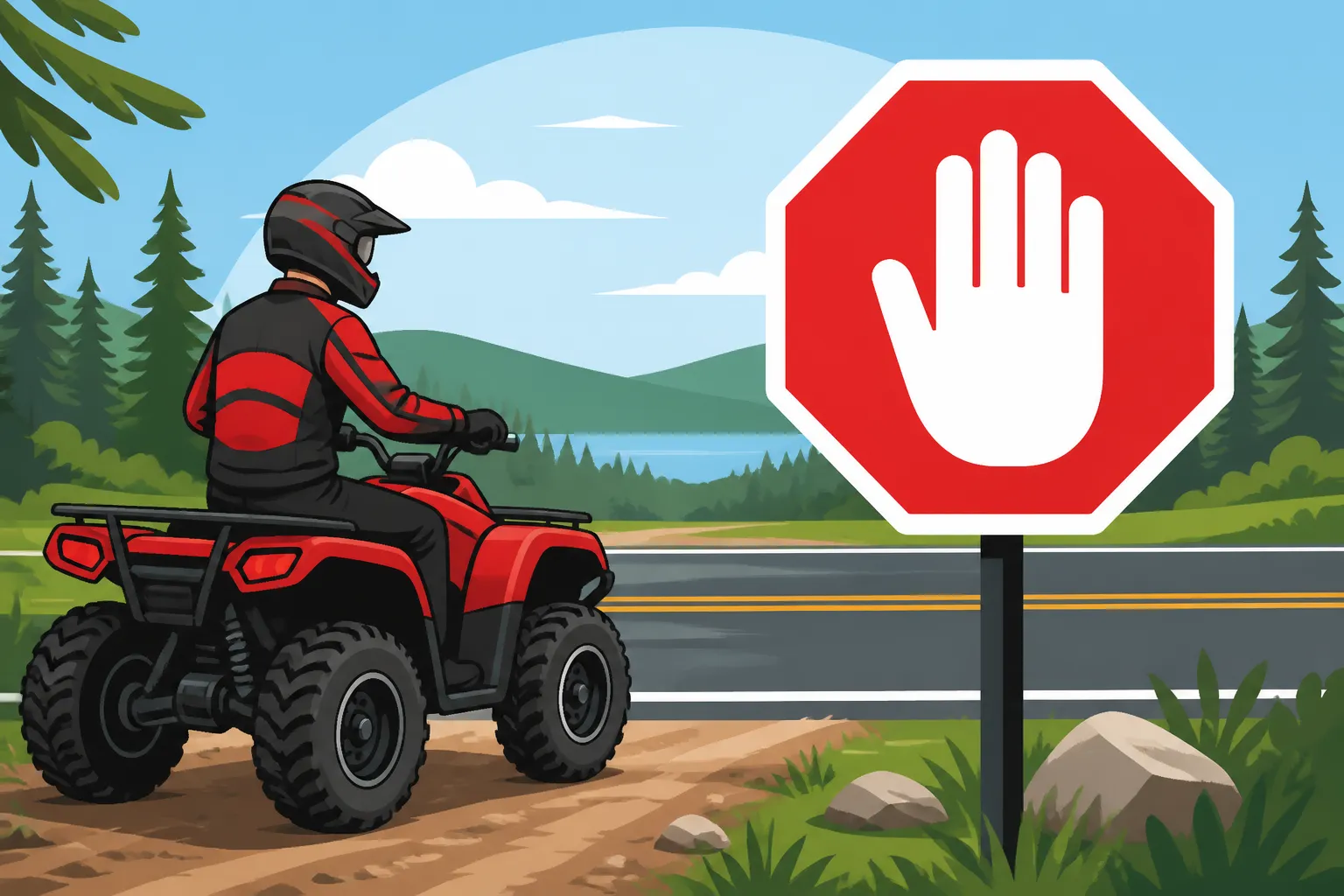
Let's be absolutely clear: a "complete stop" means your ATV or UTV must come to a full, absolute halt. Your wheels must stop turning. It's not a rolling stop where you slow down to a crawl and then ease onto the road. It's not a quick "hesitation" before you merge. Think of it exactly as you would at a stop sign in your car – you stop completely, assess the situation, and then proceed when it is safe.
Imagine you're cruising along a beautiful, winding trail in the western mountains, and you see the trail open up to a paved road ahead. You might be feeling the momentum, ready to hit the next section of trail. But before your front tires even touch the edge of that pavement, you need to bring your machine to a complete standstill. This means applying the brakes, coming to a full stop, and putting your feet down (or staying safely seated in a UTV). Take a moment. Look left, look right, look left again. Listen for approaching vehicles. Consider the visibility – is there a blind corner? Is your view obstructed by trees or a bank? Only when you've fully assessed the situation and determined it's safe to proceed should you move forward. Rushing this can lead to you pulling out directly into the path of an oncoming vehicle, a mistake that could cost you far more than a few extra seconds. Wardens are very aware of this specific rule and its importance, so they are often looking for those rolling stops.
The Rationale Behind This Safety Measure
The "complete stop" rule isn't an arbitrary hurdle designed to slow down your ride; it's a fundamental safety measure rooted in physics, visibility, and the differing dynamics of ATVs and road vehicles. Here's why it's so critical:
First and foremost, visibility is key. ATVs, while powerful, are relatively small compared to cars and trucks. When you're emerging from a wooded trail, you might be obscured by trees, bushes, or even terrain. A full stop gives you precious extra seconds to scan the road for traffic that might be in your blind spot or approaching faster than you realize. It also gives drivers on the public way more time to spot you before you enter the road.
Secondly, it's about reaction time. If you're performing a rolling stop, your machine is still in motion, and your brain is still in "trail mode." Coming to a complete halt forces you to transition mentally and physically to "road mode." It provides a vital pause, allowing you to react appropriately to any unexpected traffic or hazards. A driver approaching at 55 mph needs a significant amount of distance to stop, and if you suddenly pull out, that distance might not be there.
Finally, the rule helps prevent collisions at intersections, especially those with limited sight lines. Many trail crossings are at sharp angles or on curves, making it difficult to see oncoming traffic until the last moment. By requiring a full stop, the law minimizes the chances of a rider inadvertently driving into the path of a vehicle. It's about acknowledging the inherent dangers of mixing off-road vehicles with highway traffic and implementing a simple, yet highly effective, safety protocol. This ties directly into [Maine's Stop-and-Yield Rule Before a Public Way], emphasizing the responsibility placed on the ATV operator.
Navigating Maine Roads: Crossings, Access Routes, and the 500-Yard Limit
While the ideal ATV experience might be entirely off-road, the reality of Maine's vast trail system often involves brief interactions with public ways. Knowing the specific rules for crossings, designated access routes, and the limited allowance for road travel is essential for a safe and legal ride.
Specific Rules for Crossing Public Ways
Crossing a public way on your ATV requires extreme caution and adherence to specific rules, even beyond the complete stop. Once you've stopped completely and determined it's safe to proceed, you must cross the public way at an angle of approximately 90 degrees to the direction of the travel lane. You cannot merge onto the public way and ride parallel to traffic for any significant distance unless it's a specifically designated access route (which we'll discuss next). The goal is to minimize your time exposed to road traffic.
Think of it this way: you are a pedestrian crossing a busy street, but on an ATV. You look both ways, you stop, and then you cross directly and quickly. You are not allowed to ride down the shoulder or meander across. If you're coming out of a trail and need to get to another trail directly across a paved road, make your complete stop, check for traffic, and then cross perpendicular to the flow of traffic. Do not try to make a turn, even a slight one, unless you are on a specifically marked ATV-access route. This rule is crucial for visibility and predictability; drivers expect to see vehicles moving along the road, not crossing it from a perpendicular angle unless at a designated intersection. Violating this can be particularly dangerous, especially if you're trying to cross [Crossing a Maine Highway on an ATV].
Understanding ATV-Access Routes and Designated Areas
Not all interactions with public ways are simple crossings. Maine law allows towns to designate certain sections of public roads as "ATV-access routes." These are specific, clearly marked segments where ATVs are permitted to travel on the public way for a limited distance to connect trail sections, access services like gas stations or restaurants, or reach trailheads. These routes are usually marked with distinct signs that state "ATV ACCESS" or "ATV ROUTE."
When you encounter an ATV-access route, the "complete stop" rule still applies before you enter that public way. However, once you are on the designated access route, you are permitted to travel with vehicle traffic, but with specific conditions. You must always ride on the extreme right-hand side of the paved or gravel road, stay as far to the right as safely possible, and obey all traffic laws, including speed limits, stop signs, and yield signs. These routes are a privilege, not a right, and their continued existence depends on responsible rider behavior. Always look for [Maine ATV-Access Routes and How Towns Post Them] and respect the posted rules. These routes are critical for connecting Maine's sprawling trail system and providing access to essential services in [Maine Towns With ATV-Friendly Main Streets].
The "500-Yard Limit" and How to Measure It
Beyond designated access routes, Maine law also includes a "500-yard limit" for ATVs on public ways. This rule allows an ATV to travel up to 500 yards (about three tenths of a mile) on a public way for the sole purpose of gaining access to another trail or private property. This is a very limited exception and is not meant for general road use or sightseeing.
The 500-yard limit is designed for those situations where a short stretch of public road is the only feasible way to connect two segments of trail or reach a specific destination. Think about riding down a logging road that suddenly turns into a public town road for a brief stretch before diving back into the woods. In such a scenario, you are permitted to ride that short distance on the public way.
However, just like with ATV-access routes, the complete stop rule applies before you enter the public way. When traveling under the 500-yard limit, you must still ride on the extreme right-hand side of the road and obey all traffic laws. It's crucial to understand that this is a maximum distance, not a target. If you can achieve your objective by traveling less than 500 yards, do so. Measuring this accurately in the woods can be tricky, so it's always best to err on the side of caution. Many riders use GPS devices with distance tracking features, or simply look for landmarks if they know the distance. Remember, this is about necessity, not convenience. For a deeper dive into this specific rule, check out [Maine's 500-Yard Limit on a Public Way].
Beyond the Stop: Yielding, Right-of-Way, and Traffic Interaction
Making a complete stop is a crucial first step, but what happens after you stop is just as important. Once you've paused at the edge of a public way, you enter the complex world of shared roads, where understanding right-of-way and how to interact with other vehicles is paramount for your safety and the safety of everyone else.
Who Yields to Whom? ATV vs. Vehicle Traffic
When you're operating an ATV or UTV and preparing to enter or cross a public way in Maine, the rule is crystal clear: you must yield to all vehicular traffic already on the public way. This means cars, trucks, motorcycles, bicycles – they all have the right-of-way over your ATV when you are attempting to enter or cross their travel lane. This isn't a suggestion; it's a legal requirement and a fundamental safety principle.
This yielding responsibility extends beyond just waiting for immediate oncoming traffic. It means you must ensure there's enough clear space, both in terms of distance and time, for you to safely enter or cross the road without forcing any other vehicle to slow down, swerve, or take evasive action. It means you must be patient, even if it feels like you're waiting a long time. Trying to squeeze into a gap that's too small or underestimating the speed of an approaching vehicle is a recipe for disaster. Never assume a driver sees you or will slow down for you. Always be prepared to wait until the road is completely clear. This concept is thoroughly covered in [ATV Yield Rules in Traffic]. It's about defensive driving – or in this case, defensive riding – and prioritizing safety above all else.
Riding the "Extreme Right" on Public Ways
If you are on a designated ATV-access route or utilizing the 500-yard limit to connect trails, you are permitted to travel on the public way. However, this comes with a strict requirement: you must ride on the extreme right-hand side of the traveled portion of the public way. This isn't just about hugging the shoulder; it means staying as far to the right as is safely possible without driving off the paved or gravel surface into ditches or onto unstable ground.
The purpose of this rule is to maximize the safe passing room for other vehicles. Cars and trucks are often wider and faster than your ATV, and they need space. By staying to the far right, you allow them to pass you safely without having to cross the center line or slow down unnecessarily. This also makes you more predictable for other drivers, reducing confusion and the potential for accidents. Think of it as sharing the road respectfully. Never ride side-by-side with another ATV on a public way unless the lane is exceptionally wide and specifically designated for such, which is rare. Always ride single file when on an access route or during a 500-yard crossing. For more details on this, refer to [Riding the Extreme Right of a Maine Road].
Situational Awareness: Interacting with Drivers and Pedestrians
Successfully navigating public ways on your ATV demands constant vigilance and a high degree of situational awareness. It's not just about obeying the letter of the law; it's about anticipating, communicating, and reacting.
Anticipate: Drivers in cars and trucks might not expect to see an ATV on the road, especially on quieter routes or emerging from trails. Assume they haven't seen you until you have clear eye contact or a discernible signal. Be prepared for sudden stops, turns, or lane changes from other vehicles.
Communicate: Use hand signals if you intend to turn, even if your ATV has turn signals. Make eye contact with drivers. A friendly wave can sometimes help establish your presence. Avoid aggressive riding or gestures that could escalate tension with other road users.
React: Always be ready to react defensively. If a vehicle is approaching too fast, or if a driver seems distracted, give them extra space. If you're riding with a group, ensure everyone maintains appropriate spacing and follows the rules. Remember, you are operating a motor vehicle on a public road, and you have responsibilities. This also extends to pedestrians or cyclists you might encounter on quieter roads; slow down, give them a wide berth, and be courteous. Being a good ambassador for the ATV community helps maintain positive relations with both the general public and landowners.
Penalties and Safety: The Consequences of Non-Compliance
Ignoring the "complete stop" rule or other regulations for ATVs on public ways isn't just a minor infraction; it carries significant legal and personal consequences. Maine Wardens take these rules very seriously, and for good reason – they are directly tied to preventing serious accidents.
Fines, Penalties, and Registration Implications
If a Maine Warden observes you failing to make a complete stop, or otherwise violating road-use rules, you can expect to be pulled over. The immediate consequence will likely be a citation. While specific fine amounts can vary, they are not trivial. These aren't just minor warnings; they are tangible penalties that can put a dent in your wallet. Depending on the severity of the violation, repeated offenses, or other accompanying infractions (like an unregistered ATV or operating under the influence), the penalties can escalate significantly. For example, riding an [Fine for an Unregistered ATV in Maine] is a separate, serious offense, and if you combine that with a failure to stop, you're looking at multiple citations.
Beyond the monetary fines, violations can have other implications. You might be asked to show proof of ownership, your registration, and if you are under 16, proof of a safety course. Consistent violations can even impact your privilege to operate an ATV in Maine. The Maine Warden Service has a strong presence on ATV trails and public ways, and they are specifically trained to enforce these regulations. Their presence is for your safety and the safety of the public, and they are not hesitant to issue citations when rules are broken. Understanding what [Maine Warden Service ATV Patrols] look for can help you avoid these situations.
The Real-World Risk of Accidents
Far more serious than any fine is the profound real-world risk of an accident when an ATV illegally or unsafely interacts with a public way. ATVs are not designed for road travel. They have a higher center of gravity, different braking characteristics, and are less visible than standard road vehicles. When an ATV collides with a car or truck, the ATV operator and any passengers are almost always at a severe disadvantage.
The potential outcomes of such a collision are grim:
- Serious Injury or Fatality: ATVs offer very little protection in a collision. Riders can be ejected, crushed, or suffer catastrophic injuries.
- Property Damage: Your ATV will likely be severely damaged, and the other vehicle involved will also sustain damage.
- Legal Liability: If you are found to be at fault for failing to yield or stop, you could face significant civil liability for the other party's medical bills, vehicle repairs, and other damages. This is where the question of [Who Pays After an ATV Road Collision] becomes critically important, and if you're at fault, it could be a massive financial burden.
- Insurance Complications: Your ATV insurance, if you have it (and it's highly recommended, even if not strictly required in all situations), might not cover incidents that occur while you were breaking the law or operating unsafely on a public way. This can leave you financially exposed.
The rules about stopping and yielding are not arbitrary bureaucratic hurdles. They are established in blood and experience, designed to prevent these tragic outcomes. Every time you ride, especially when approaching a public way, you are making a choice. Choose safety. Choose compliance. It's simply not worth the risk to cut corners on these fundamental rules.
Equipping Your Machine for Road Sections: Safety Gear and Modifications
Even though ATVs are primarily off-road machines, interacting with public ways, even briefly, demands that your machine be adequately equipped for safety and visibility. While you're not trying to make your ATV street-legal in the same way a car is, specific enhancements can drastically improve your chances of being seen and heard by other drivers.
Essential Lighting and Reflective Gear
When you're riding on a public way, even for a short crossing or an access route, your visibility to other drivers is paramount, especially during dawn, dusk, or any low-light conditions. Your ATV might have basic headlights and a taillight, but for any road interaction, it’s wise to ensure they are fully functional and as bright as possible.
Consider adding aftermarket lighting. LED light bars can significantly improve your forward visibility, and additional taillights or brake lights can make you much more noticeable from the rear. Many riders also add reflective tape to the sides and rear of their machines. This inexpensive addition can make a huge difference in how early other drivers spot you. Remember, [Maine Lighting Requirements for Night Riding] are strict, and even during the day, enhanced lighting can increase your safety profile. Ensuring your existing lights are clean and operational is a basic but often overlooked step. Think about where your machine might be obscured from a driver's view and add lighting or reflective elements accordingly.
Mirrors, Horns, and Other Road-Focused Accessories
While not always strictly mandated for ATV road crossings, certain accessories are incredibly valuable for safe interaction with public ways, especially on ATV-access routes.
Mirrors: Side mirrors are incredibly useful, allowing you to monitor traffic behind you without constantly turning your head. This is particularly important if you're riding on the extreme right of a public way and need to be aware of vehicles attempting to pass you. Many aftermarket companies, including SuperATV, offer robust, vibration-resistant mirror kits designed specifically for ATVs and UTVs. Adding mirrors greatly enhances your situational awareness and adherence to [Maine ATV Mirror Rules] when applicable for specific routes.
Horn: A loud, clear horn is an essential communication tool on any public way. While you hope to never need it, a horn can alert an inattentive driver, signal your presence, or warn pedestrians. Many ATVs come with rudimentary horns, but an aftermarket horn can offer a much more commanding sound, especially important when sharing the road with louder trucks.
Turn Signals: While not always required for simple crossings, if you're using an ATV-access route that involves turns on a public way, having functional turn signals is a significant safety upgrade. Many aftermarket kits are available to add these to your ATV or UTV, improving your ability to clearly signal your intentions to other drivers. These additions, even if not mandatory, demonstrate a commitment to safety and responsible riding. Companies like SuperATV provide a wide array of accessories from lighting to mirrors and even full street-legal kits for those looking to heavily modify their UTVs for very specific types of road use (though full street legality for ATVs in Maine is very limited).
Helmet and Eye Protection: Always a Good Idea, Often Required
Regardless of whether you're on a trail or briefly on a public way, wearing appropriate safety gear is non-negotiable. While Maine's helmet laws primarily focus on riders under 18, wearing a helmet is strongly recommended for all ATV operators, regardless of age, especially when there's any chance of interacting with vehicle traffic.
A DOT-approved helmet provides crucial head protection in the event of a fall or, far worse, a collision with a motor vehicle. The forces involved in a road accident are significantly higher than most trail incidents, making a helmet your most important piece of protective gear. For young riders, the law is clear: [Maine Helmet Rules for Riders Under 18] mandate helmet use, and this applies equally on public ways as it does on trails.
Eye protection, whether goggles or a face shield, is also critical. Not only does it protect your eyes from dust, debris, and insects, but it also ensures clear vision, which is absolutely essential when scanning for traffic on a public way. A split second of impaired vision could lead to a missed car or an misjudgment of speed. So, before you even think about engaging with a public way, make sure you're geared up responsibly.
| Public Way Interaction Type | Complete Stop Required | Yield to Traffic | Ride Extreme Right | 500-Yard Limit Applies | Designated Route Signs Required |
|---|---|---|---|---|---|
| Crossing a Public Way | Yes | Yes | No (Cross @ 90°) | No | No |
| ATV-Access Route Travel | Yes (upon entry) | Yes | Yes | No (Route Specific) | Yes |
| Connecting Trails (500-yd) | Yes (upon entry) | Yes | Yes | Yes | No |
| Riding to Gas Station | Yes (upon entry) | Yes | Yes | Yes (if <500 yd) | Yes (if designated route) |
Disclaimer
This article is for general informational purposes only and does not constitute professional advice. Laws, prices and regulations vary by location and change over time. Consult a qualified professional for guidance on your specific situation.