Overnight Trailer Parking in Trail Towns
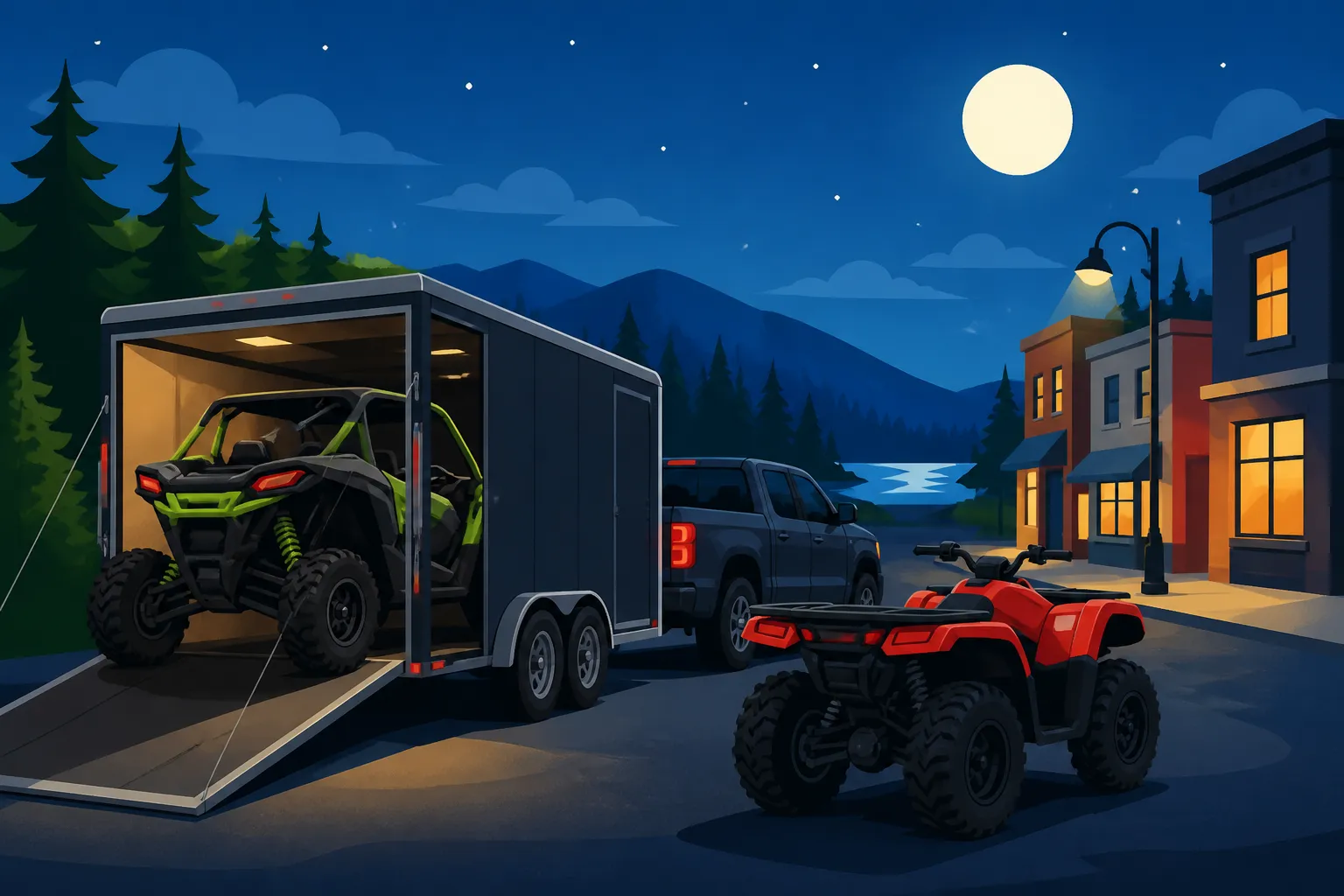
Finding a place to leave an ATV trailer overnight in a Maine trail town can be harder than planning the ride itself. A lot that works for unloading at breakfast may not allow overnight parking, and a trailhead with room for a truck and trailer may not permit multi-day storage. This guide explains how to confirm permission, choose a safer spot, and avoid last-minute surprises.
Confirm overnight permission before you unload
Treat trailer parking and trail access as separate questions
A place where riders commonly stage machines is not automatically a place where you can leave a truck and trailer overnight. Parking may be allowed during the day but restricted after hours, limited to customers, or unavailable during events or maintenance. Even a spacious gravel lot can have rules that are easy to miss if you arrive after dark.
Ask specifically about your whole setup: tow vehicle, trailer, and the number of nights you plan to leave them. Confirm whether you can park while riding from a nearby trail, whether you need to be a customer, and whether your trailer can remain after your tow vehicle leaves. If you are traveling with a group, ask about the total number of spaces needed; a spot that fits one rig may not accommodate several.
This is especially important when visiting trail towns such as Greenville, Millinocket, Jackman, Presque Isle, or Fort Kent. These are useful places to plan a ride or overnight stay, but parking rules can vary by property and season. Do not assume that a business, trailhead, or municipal lot allows unattended trailers just because other riders have parked there before.
Get the details from the person responsible for the lot
Contact the property owner, lodging operator, business, town office, or trail organization that manages the location. A general “Can I park there?” may lead to a yes that only covers short-term parking. Instead, explain your plan: “Can I leave my truck and enclosed trailer here overnight while we ride, and can it stay there for two nights?”
Confirm the practical details while you have someone’s attention. Ask where the rig should be parked, whether there are posted hours, whether you need to register your vehicle, and whom to call if your plans change. If permission comes from a business, check whether it applies only while you are a paying customer. If it comes from a town or club representative, ask whether the permission applies to the exact lot you intend to use.
Keep a written record of the answer, such as a message or email. This is not a substitute for posted rules, but it helps prevent a misunderstanding when staff change or you arrive outside normal business hours. If the answer is uncertain, treat that as a reason to find another option rather than leaving the rig and hoping it will be fine.
Check the full trip plan, not just the parking pin
Use a map to understand how the parking location relates to your lodging, trail access, and planned route. onX Offroad can help you review the route and surrounding geography, but a map pin does not confirm that parking is permitted or that a trail is open. Confirm access and parking separately with the relevant landowner, club, business, or local office.
Maine trail access often depends on private-land permission and local trail conditions. A route that appears connected on a map may not be open to the public, and access may change. Before you tow to a town, check [Checking Maine Trail Status Before You Drive] and review [Maine ATV Trail Maps and Club Boundaries]. If your route depends on a particular trailhead, verify that the staging area is open and suitable for your trailer.
Compare your overnight parking options
The right choice depends on how long you will be away from the rig, whether you need trail access directly from the lot, and what services matter to you. A motel or campground may offer a convenient place to park for guests, while a designated trailhead may be better for unloading but not allow overnight storage. A business lot might work by arrangement, but only with clear permission.
| Parking option | What may make it useful | What to confirm |
|---|---|---|
| Lodging property | Convenient when you are staying overnight | Guest-only rules, trailer space, number of nights, and whether the vehicle can remain while you ride |
| Campground | May suit longer stays or groups | Whether trailers are allowed in the assigned site or a separate parking area |
| Designated staging area | Can make unloading and trail access easier | Overnight rules, posted limits, hours, and whether unattended rigs are allowed |
| Business lot by arrangement | Could work when a business is open to hosting riders | Written permission, customer requirements, parking location, and event or seasonal restrictions |
| Town or municipal lot | May be practical in some locations | Local rules, overnight restrictions, trailer limits, and any permit or time limit |
Lodging and campgrounds
If you are staying in town, start by asking your lodging provider whether trailer parking is permitted for guests. Explain the trailer’s approximate length and whether you will need room to turn around. Some properties may have enough space for a pickup but not for a long trailer, or may direct guests to a separate area. Confirm before booking if your rig is a key part of the trip.
Campgrounds can be a good fit when you want to stay more than one night, but do not assume a campsite can double as trailer storage. The campground may require the truck and trailer to remain at your site, or it may have a separate parking area with its own rules. If you are riding from the campground, ask whether the connecting route is legal and open, rather than relying on a line shown on a phone map.
For more planning ideas, see [Maine ATV Trail Camping and Lodging] and [Trailside Lodging in Northern Maine]. When comparing places to stay, ask about trailer access before you focus on amenities. A comfortable room is less helpful if the parking area cannot safely fit your rig.
Staging areas and business lots
A designated staging area is often designed for loading, unloading, or beginning a ride. That does not necessarily mean it is intended for overnight storage. Look for posted signs, and contact the organization responsible for the area if the rules are not clear. Ask whether a trailer can remain after the rider has left the lot and whether overnight parking is allowed on weekdays, weekends, or during a specific season.
A nearby business may be willing to accommodate riders, particularly if you are a customer, but ask rather than treating an open lot as public parking. Do not block delivery areas, fire lanes, entrances, snow-removal space, or access needed by the property owner. If the lot is busy, ask where the rig should go so it does not interfere with customers or operations.
For broader staging considerations, review [Maine ATV Trail Parking and Staging] and [Trailhead Parking That Fits a Trailer]. They can help you think through trailer access and space needs, but always confirm a specific location’s current rules directly.
Choose a spot that works for your trailer and your ride
Measure and describe the rig accurately
“Truck and trailer” can mean very different things. A short utility trailer may fit where a long enclosed trailer cannot. Before asking for permission, estimate the overall length of the truck and trailer together, the trailer width, and the turning space you need. If you are towing a wide machine or carrying more than one ATV, mention that too.
Think about how you will enter and exit. A tight lot may technically have enough straight-line space but leave no room to turn around. Gravel shoulders, steep entrances, low branches, and soft ground can also make a parking spot unsuitable. If the person granting permission is unfamiliar with trailers, describing the rig clearly can prevent an awkward arrival.
For a group, plan for each vehicle rather than counting only machines. Two ATVs in one trailer still arrive with a tow vehicle; two trailers may need separate maneuvering room. Share the number of rigs, expected arrival time, and departure time. This helps the property owner make a realistic decision and gives you a chance to adjust before you are on the road.
Consider security without assuming a lot is monitored
An authorized parking spot is not necessarily a secured lot. Ask whether the area is gated, lit, or monitored, but do not treat any of those features as a guarantee against theft or damage. Avoid leaving registration documents, keys, tools, riding gear, or valuables visible in the vehicle. Lock the trailer and secure the ATV using appropriate equipment.
Take a few photos of the parked setup when you arrive, including the trailer and nearby surroundings. These can help you remember where you left the rig and document its condition. If you are staying overnight, keep the contact information for the property owner or manager handy. Let them know if you expect to return later than planned or need to leave earlier.
Store registration paperwork safely and bring any documents required for the ride. The practical advice in [Storing Registration Paperwork on the Machine] and [Do You Carry Registration Papers While Riding?] can help you decide how to handle riding documents without leaving sensitive information in an unattended vehicle.
Match parking to your riding route
A convenient lot is not useful if reaching the trail requires riding illegally on a road or crossing land without permission. Verify how you will get from the parking location to an open trail. Check local route rules, posted signs, and club guidance; do not assume a nearby road is an ATV-access route. If you need to trailer the machine to a trailhead each day, make sure the parking arrangement allows you to return and reload.
Route planning tools, including onX Offroad, can help you orient yourself and compare possible routes, but they cannot replace local confirmation about permission, closures, or parking rules. In Maine, private-land access is a major part of trail riding, so respect signs and directions from landowners and clubs. [Maine Trail Etiquette With Landowners] is useful background when your route passes through working land or near homes.
If the trail plan changes because of weather or a closure, know where you can safely regroup and whether your parking permission still applies. Check [Maine ATV Trail Closures Mid-Season] if you are planning around a specific trail system, and confirm changes with the organization responsible for that trail.
Use a practical checklist before leaving the rig overnight
Ask these questions before you arrive
A short call or message can save a long, stressful search for parking after towing into town. Keep your questions concrete and repeat the details back so both sides understand the arrangement.
- Is overnight parking allowed for a truck and trailer, rather than only a passenger vehicle?
- How many nights may the rig remain?
- Must we be lodging guests or customers?
- Where should the trailer be parked, and is there enough room to turn around?
- Can the trailer remain while the tow vehicle is used elsewhere?
- Are there posted time limits, gates, event dates, or seasonal restrictions?
- Is there a fee, permit, or registration process?
- Who should we contact if our arrival or departure time changes?
If you are traveling during a busy weekend or foliage season, make the call early. A location that can accommodate one trailer on a quiet weekday may not have room when multiple groups arrive. Do not wait until you reach the trail town to discover that overnight parking is limited.
Make a simple arrival and departure plan
Arrive during daylight when possible. It is easier to spot signs, judge turning space, and avoid blocking other vehicles when you are not maneuvering in the dark. Once parked, follow the agreed instructions, take a photo of the rig and location, and make sure the trailer is not obstructing access. Keep the contact number for the person who approved the parking.
Before leaving for the trail, confirm that the vehicle and trailer are locked and that anything visible has been removed or covered. Do not leave food, fuel, or loose equipment outside the rig. If you return after the property closes, check in advance whether the lot remains accessible and whether a gate or barrier could prevent you from retrieving your trailer.
When you leave, pick up litter and check the parking area for straps, tools, or gear. A clean departure is a small courtesy that helps preserve goodwill with businesses, landowners, and communities that host riders. That goodwill matters: Maine’s trail network depends heavily on continuing access and considerate behavior.
Have a backup instead of improvising
Before the trip, identify a second parking possibility and confirm its rules too. A backup could be a different lodging property, campground, or staging location, but it should be a real option with explicit permission—not an unverified map pin. If the first choice is full, closed, or unsuitable for your trailer, you will have somewhere legitimate to go.
Keep your backup plan flexible. You might need to change towns, split up the group, or trailer to a different access point. If the ride depends on a route that connects multiple communities, plan where you can park and retrieve the rig at each end. Articles such as [Planning a Multi-Day Ride Across Maine Trails] and [Overnight Trailer Parking in Trail Towns] can help frame the logistics, but a direct confirmation from the lot’s responsible contact should guide your actual parking decision.
A few minutes of planning can spare you from circling a trail town with a loaded trailer, worrying about a tow-away sign, or leaving your equipment somewhere without permission. Confirm the location, confirm the time window, and confirm the route from parking to trail before the ride begins.
Disclaimer
This article is for general informational purposes only and does not constitute professional advice. Laws, prices and regulations vary by location and change over time. Consult a qualified professional for guidance on your specific situation.