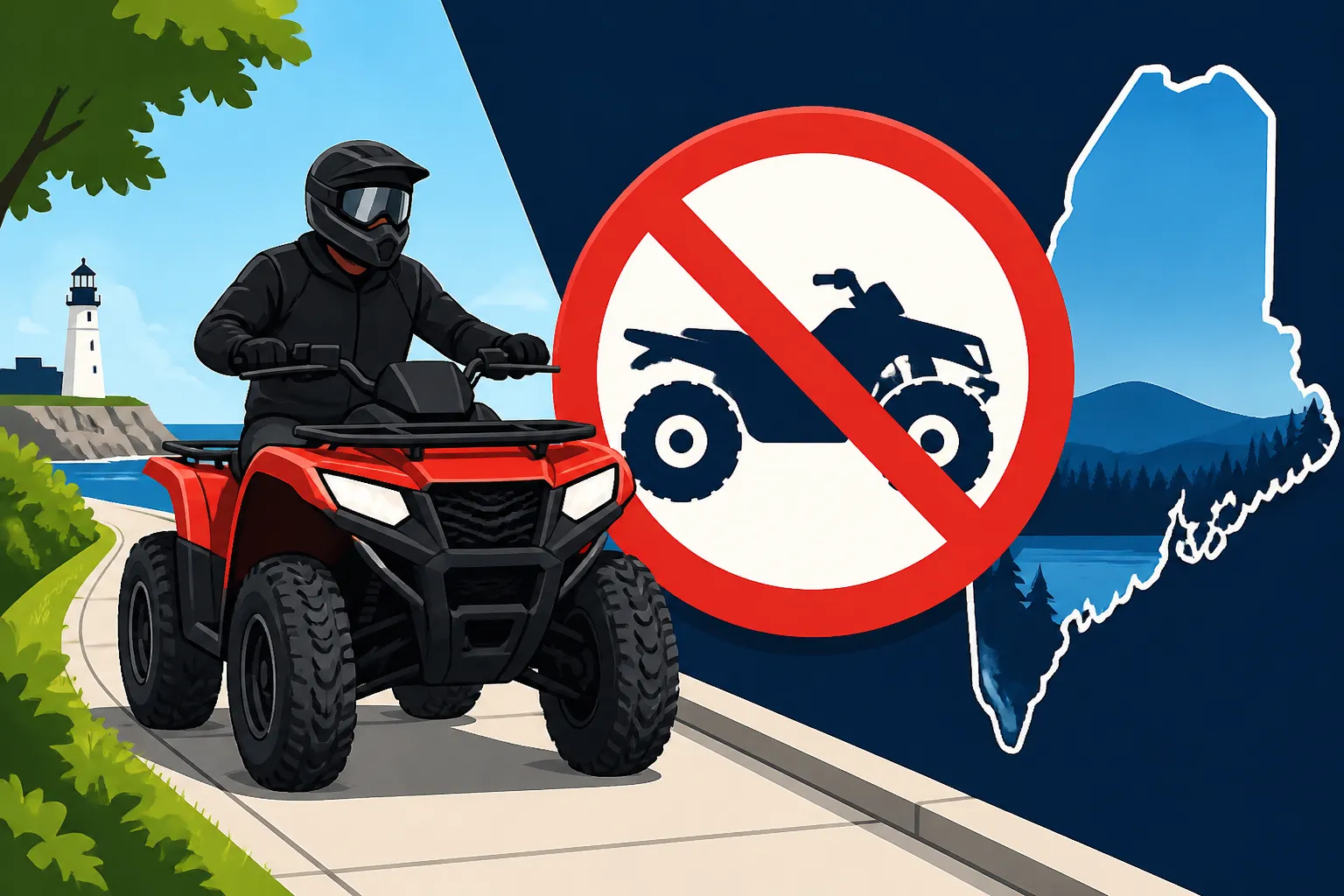
Maine Rules for ATVs on Sidewalks
It's incredibly tempting sometimes, isn't it? You're cruising along on your ATV or UTV, maybe just needing to get to a gas station or a friend's house just a short distance down the road, and you see that nice, smooth, paved sidewalk running parallel to the street. Your brain might even whisper, "Just for a few feet, no one's around!" But here in Maine, that's a shortcut you absolutely, positively cannot take. This guide is going to walk you through exactly why sidewalks are off-limits for ATVs and UTVs, what the law says, and the serious repercussions of ignoring those rules.
The Strict Truth About Sidewalks and ATVs in Maine
Let's get straight to the point: riding an ATV or UTV on a sidewalk in Maine is against the law. Period. It's not a gray area, it's not a suggestion, and it's certainly not something you should ever attempt, no matter how convenient it might seem for a moment. This rule is in place for very good reasons, primarily safety and the preservation of infrastructure that simply isn't designed to handle the weight and wear of off-road vehicles.
The temptation is real, especially if you're trying to avoid a busy road or navigate a tricky intersection. You might think, "It's just like a paved trail, right?" Wrong. The distinction is critical, both legally and practically. Understanding this difference can save you a heap of trouble, not to mention keep pedestrians safe. It's a fundamental aspect of responsible ATV and UTV ownership in our beautiful state.
Why Sidewalks Are Off-Limits (and It's Not Just About Common Sense)
While common sense certainly plays a huge role in dictating that a loud, heavy motorized vehicle doesn't belong where people are walking, the law is very specific. Sidewalks are reserved for pedestrian traffic. They are an extension of private property in many ways, dedicated walkways for people, not thoroughfares for machines. When you consider the purpose of a sidewalk—to provide a safe space away from vehicle traffic for walkers, runners, and those with strollers or wheelchairs—it becomes clear why ATVs are prohibited.
Imagine a child stepping out from behind a bush onto a sidewalk, expecting only foot traffic, and suddenly encountering an ATV. The potential for a serious accident is immediate and severe. Furthermore, sidewalks are simply not built to withstand the weight and torque of an ATV or UTV. The concrete or asphalt can crack, heave, and crumble under the stress, leading to costly repairs for the town and creating trip hazards for pedestrians. This isn't just a minor infraction; it's a direct threat to public safety and infrastructure integrity, a core principle found in many [Maine ATV Road Rules for Young Riders] and beyond.
The Definition of a Sidewalk in Maine Law
In Maine, a "sidewalk" is legally defined as that portion of a public way between the curb line or the lateral line of a roadway and the adjacent property line, intended for the use of pedestrians. This definition is crucial because it distinguishes sidewalks from other paved or unpaved areas that might run alongside a road. It's not just any paved strip; it's specifically the designated pedestrian zone.
This legal clarity means there's no room for interpretation. Even if a particular sidewalk looks wide, appears unused, or seems like it could handle your machine, it's still legally off-limits. This definition helps avoid ambiguity for riders who might otherwise mistake a wide shoulder, a bike path, or even a section of an abandoned road as an acceptable route. It's important for riders to respect these clear definitions and understand that their machine belongs on designated trails or legally permitted road sections, not where folks are taking their morning stroll or walking their dogs.
Penalties and Risks: What Happens If You Ride on a Sidewalk
Riding an ATV or UTV on a sidewalk isn't just a frowned-upon activity; it carries genuine legal and personal risks. It’s not one of those minor infractions that might just get you a warning. Wardens and local law enforcement take these violations seriously because of the inherent danger they pose to the public and the potential damage to municipal property. Thinking you can sneak by is a gamble that's almost never worth the potential fallout.
The consequences can range from significant financial penalties to more severe legal troubles, especially if an accident occurs. Beyond the legal ramifications, there's the moral and community aspect. Responsible riders are stewards of the trail system and local access. Violating clear rules like this can lead to negative perceptions of all ATV and UTV enthusiasts, potentially jeopardizing access in other areas.
Legal Consequences: Fines, Charges, and More
If you're caught riding your ATV or UTV on a sidewalk in Maine, you're likely looking at a pretty hefty fine. The specific amount can vary depending on local ordinances and the discretion of the enforcing officer, but it's safe to say it won't be a pleasant surprise. Wardens and municipal police are actively patrolling, and they are well-versed in ATV and UTV regulations. A momentary lapse in judgment could easily cost you hundreds of dollars. You can learn more about common citations by looking at [Fines Maine Wardens Write Most Often].
Beyond the monetary fine, you could face other charges. If your operation is deemed reckless or if you cause any damage to the sidewalk or other public property, those additional charges will stack up. In some cases, repeated violations could even lead to your machine being impounded, or your registration being suspended. And if, heaven forbid, you were to injure a pedestrian, you could be looking at serious criminal charges and civil lawsuits, not to mention the immense personal guilt. [Maine Penalties for Trespass on an ATV] also apply, as a sidewalk is certainly not an open area for ATV travel.
The Real-World Dangers: Beyond the Law
Beyond the legal penalties, the real-world dangers of riding on a sidewalk are profound and frankly, terrifying. Sidewalks are full of blind spots: hedges, parked cars, buildings, even mailboxes can obscure your view of a child darting out, an elderly person using a walker, or someone pushing a stroller. ATVs and UTVs are powerful machines, and even at low speeds, a collision with a pedestrian can have catastrophic consequences. The sounds of your engine can also startle pedestrians, leading to falls or other accidents.
Then there's the property damage aspect. Sidewalks are not designed for heavy, motorized vehicles. Riding on them can crack pavement, break curbs, and damage underground utilities. It can also churn up grass and landscaping adjacent to the sidewalk, creating an eyesore and requiring costly repairs. Your insurance company might not be thrilled either if you're involved in an accident while illegally operating your machine. In fact, most standard ATV insurance policies might deny coverage for incidents occurring during illegal operation, leaving you personally liable for damages and injuries. This is a crucial point when considering [Maine ATV Insurance and When You Need It]—it's there for legal riding.
Where You Can Ride Your ATV or UTV Legally Near Towns (The Alternatives)
So, if sidewalks are a no-go, where can you ride your ATV or UTV when you're near towns or need to connect to a trail system? Maine has an incredible network of trails and a system for designated access that allows riders to get around responsibly and legally. The key is to know these options and always adhere to posted signage and local regulations. The good news is that Maine is very ATV/UTV friendly, provided you know and follow the rules.
It's about being informed and respecting the established pathways. Maine's trail system is maintained by dedicated clubs and volunteers, often with the cooperation of private landowners and municipalities. Abusing access points or ignoring rules can jeopardize these privileges for everyone, which is why adherence to designated routes is paramount. Always plan your route in advance, especially when transitioning between official trails and any road segments.
Designated ATV-Access Routes and Shared Ways
Many towns across Maine have recognized the popularity of ATV and UTV riding and have taken steps to create designated ATV-access routes. These are specific sections of public roads—often dirt roads, less-trafficked paved roads, or shoulders—that have been officially opened for ATV and UTV use. These routes are always clearly marked with signage indicating that ATVs and UTVs are permitted. It's crucial to look for these signs; if you don't see them, assume the route is not open for motorized vehicle access.
These access routes are a lifeline for riders, allowing them to connect trail sections, reach local businesses, or access fuel and food. When riding on these designated routes, you must always observe road rules, speed limits, and respect private property boundaries. Remember, these are privileges, not rights, and they can be revoked if abused. It’s also important to distinguish these designated routes from the general rule of [Maine's 500-Yard Limit on a Public Way], which allows for very short distances on roads for specific purposes, but isn't the same as an established access route. Always check [Maine Towns That Restrict ATVs on Public Ways] for specific local ordinances that might affect your ride.
Trail Networks and Connecting Segments
Maine boasts an extensive network of over [Maine's 6,000 Miles of ATV Trails], thanks to the hard work of local clubs and the Bureau of Parks and Lands. These trails are your primary legal and safest place to ride. Many of these trails intentionally connect towns, allowing riders to experience the beauty of Maine's backcountry while also supporting local economies. These trails are maintained, marked, and often cross both public and private land with permission.
Sometimes, trails will briefly utilize a short section of a public road, a culvert, or a bridge to connect two trail segments. These connecting segments will also be clearly marked. The key is to stay on the marked trail. Venturing off-trail, even for a short distance, could lead to trespassing charges, which are taken very seriously, as discussed in [Maine Trespass Law for ATV Riders]. Equip your machine properly for these varied conditions; parts from reputable brands like SuperATV can ensure your ride is trail-ready and capable of handling diverse terrain. Always check maps from ATV Maine or local clubs to ensure you're on a legal and open trail.
Understanding "Street Legal" for UTVs (and why ATVs usually aren't)
While the vast majority of ATVs are designed solely for off-road use and cannot be made street legal in Maine, some UTVs can be legally converted for limited road use. This typically involves adding specific equipment like turn signals, mirrors, a horn, a windshield, and DOT-approved tires, much like what you might find available from SuperATV. However, even if your UTV is fully street-legal and registered as such, it still cannot be ridden on sidewalks. The rules against motorized vehicles on sidewalks apply universally, regardless of the vehicle's "street legal" status.
Making a UTV street-legal is an involved process and doesn't magically grant you permission to ride anywhere. It simply allows you to operate on certain public roads where permitted, typically those with speed limits under 35 mph, and often excluding state highways or limited-access roads. The purpose of this conversion is to connect trail systems or access amenities safely and legally, not to transform your UTV into a city commuter. Always consult the Maine Bureau of Motor Vehicles for specific requirements if you're considering a street-legal UTV conversion, and remember, even then, sidewalks are for feet, not wheels. For more details, check out [Can a UTV Be Made Street Legal in Maine?].
Comparing Sidewalks vs. Legal ATV/UTV Pathways in Maine
Here's a quick rundown to help distinguish where you can and cannot ride your ATV or UTV near populated areas in Maine.
| Feature | Sidewalks | Designated ATV Access Routes | Maintained ATV Trails |
|---|---|---|---|
| Legal Status | Illegal for ATVs/UTVs | Legal (if clearly marked) | Legal (if marked and open) |
| Primary Purpose | Pedestrian travel | Connect trail segments, access services | Recreational off-road riding, scenic routes |
| Who Can Ride | Pedestrians only | ATVs/UTVs, subject to road rules | ATVs/UTVs, subject to trail rules |
| Surface Typical | Paved (concrete, asphalt) | Paved or unpaved (dirt, gravel roads) | Varied (dirt, gravel, rock, mud, paved in sections) |
| Signage | None indicating ATV use | Specific ATV access route signs (green, white) | Trail markers, directional signs |
| Risks | High risk of fines, accidents, injury, damage | Requires caution, adherence to traffic laws | Varied, dependent on trail conditions and rider skill |
| Enforcement | Strict enforcement by Wardens/Police | Enforced by Wardens/Police, local authorities | Enforced by Wardens/Police, club volunteers |
| Infrastructure | Not built for vehicle weight | Often public roads, suitable for vehicles | Designed for off-road vehicles, some bridges/culverts |
This table clearly illustrates the very distinct purposes and regulations for each type of path. Always err on the side of caution, and if you're unsure about the legality of a path, don't ride there. Your safety and the preservation of our riding access depend on it.
Disclaimer
This article is for general informational purposes only and does not constitute professional advice. Laws, prices and regulations vary by location and change over time. Consult a qualified professional for guidance on your specific situation.