Taking a Maine ATV to New Brunswick
Taking a Maine ATV to New Brunswick involves more than crossing the border with a registered machine. Maine registration does not automatically grant access to New Brunswick trails, and border, insurance, permit and riding rules may all apply. Use this planning checklist to work out what to confirm before you haul your ATV north or ride it on a trail.
Maine registration and New Brunswick trail access are separate
A Maine ATV registration identifies your machine under Maine’s rules. It does not, by itself, establish that you can ride every trail in New Brunswick. Trail access and provincial requirements are separate questions, and a registration arrangement that works for a visitor riding in Maine may not work in the reverse direction.
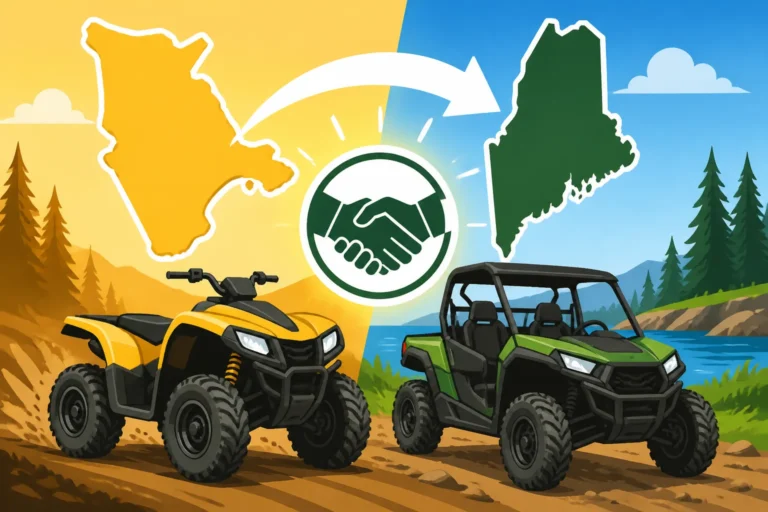
Maine has a limited arrangement involving New Brunswick and Quebec. Its scope is specific: it concerns certain out-of-state riders in Maine, not blanket permission for Maine-registered machines to use trails across the border. Read Maine’s Three-Day Agreement With New Brunswick and Quebec and New Brunswick Registrations Honored in Maine as Maine-side information—not as proof of reciprocal access in New Brunswick.
Before you leave, check current requirements with the relevant New Brunswick government office and the organization responsible for the trail system you plan to use. Ask whether a Maine registration is recognized for the type of riding you intend to do and whether you also need a non-resident registration, trail permit, or other authorization. Requirements can differ between riding on a trail system, using a road, and operating on private property.
| What you need to check | Why it matters |
|---|---|
| Maine registration and paperwork | Confirms the machine is properly registered at home and gives you documentation to carry |
| New Brunswick registration or permit | A Maine registration may not satisfy provincial or trail-system requirements |
| Trail access | A permit or registration does not necessarily authorize travel on every trail |
| Insurance | Your policy may have geographic limits or requirements for riding outside Maine |
| Border crossing and temporary entry | The machine and its intended use must be handled through an authorized crossing |
| Operator and passenger rules | Age, safety equipment and road-use requirements can differ from Maine’s |
Do not assume that buying a permit automatically solves every issue. A trail permit may grant access to a particular network while leaving provincial registration, insurance, road use or operator rules to be dealt with separately. Likewise, permission to bring an ATV into Canada does not automatically permit riding on a particular trail.
If your route starts in Maine on a trail, remember that the Maine portion has its own access rules. Trails often depend on landowner permission and may be open only for a specific season or purpose. Maine Landowner Permission Rules explains why permission in one area should not be treated as permission elsewhere. For more on how the Maine arrangement works for visiting riders, see Maine ATV Rules for Canadian Visitors.
Plan the border crossing before you plan the ride
For many riders, transporting an ATV on a trailer to an authorized land border crossing is simpler than trying to ride across the boundary. The machine should not be ridden through woods, across private land or along a road toward the border unless that is explicitly an authorized route. An ATV trail that approaches the boundary does not automatically make the border itself a legal crossing.
At the crossing, be prepared to explain who owns the ATV, where it is registered, how it is being transported and whether it will be used in Canada. Carry the machine’s registration and useful ownership documents. If the ATV belongs to someone else, is financed, or is rented, ask the owner, lender or rental provider what written authorization is needed before travel. Do not rely on an informal understanding if a border official asks who has authority to take the machine across.
The people travelling with the ATV need their own acceptable travel documents. Check current entry requirements for each person with the appropriate border authority before departure. A machine’s paperwork does not replace the documents required for its operators and passengers.
You should also confirm what temporary entry or declaration steps apply to your specific situation. The answer may depend on who owns the machine, how long it will remain in Canada and whether it is being brought in for personal recreation or another purpose. Check with the relevant Canadian border authority before travelling, especially if the ATV is being sold, left in Canada, used commercially or transported by someone other than its owner.
A practical pre-trip document folder can include:
- The ATV’s current Maine registration.
- Proof of ownership, such as a bill of sale or other ownership record.
- Written permission to transport the machine if you are not the owner.
- Insurance documents and the insurer’s confirmation of coverage in Canada.
- Any New Brunswick registration, permit or trail-access documentation required for your route.
- Travel documents for everyone in the vehicle.
- Contact details for the border office or trail organization you consulted.
Keep the registration and permit records easy to reach rather than buried under riding gear. If you keep paperwork on the machine during rides, protect it from water and damage. Do You Carry Registration Papers While Riding? and Storing Registration Paperwork on the Machine cover practical ways to handle documents on a ride.
If you are towing the ATV rather than riding it to the trail, check the trailer and vehicle setup too. A trailer that is legal and properly secured in Maine still needs to meet applicable requirements while travelling through Canada. Review Maine Trailer Registration for an ATV Trailer and Tying an ATV Down for the Highway for the Maine-side trailer and loading details, then confirm any additional requirements for the route.
Confirm permits, insurance and route permission
The key planning step is to identify the exact place you intend to ride—not just the province. New Brunswick trail access can be organized by a particular club, network or landowner, and permission for one route does not mean permission for another. Trail conditions, seasonal closures and access terms may change, so verify them close to your travel date.
When you contact the provincial authority or trail organization, ask direct questions:
- Is a Maine-registered ATV eligible to ride this trail system?
- Does a visiting rider need a separate provincial registration, trail permit or membership?
- Does the requirement apply to each ATV, each rider, or both?
- What proof must the operator carry while riding?
- Are there restrictions on machine type, width, passengers, age or operating hours?
- Are roads or connecting routes included, or are they governed by separate rules?
- Where can you confirm current closures and route boundaries?
Ask for the answer in writing or keep a copy of the official permit instructions. A verbal answer about one trail or one type of vehicle may not cover your whole itinerary. If you plan to connect separate trail systems, check each one rather than assuming a single permit covers the route.
Insurance deserves a separate check. Contact your insurer before the trip and ask whether your ATV coverage applies while the machine is in New Brunswick, including on trails and on any roads you might need to use. Confirm what liability coverage is required and whether your policy covers a passenger or another person operating the ATV. A policy that covers the machine in Maine may have territorial limits or exclusions that matter once you cross the border. Do not assume your vehicle insurance automatically covers an ATV, or that a credit card or home policy fills any gap. For general Maine coverage questions, see Maine ATV Insurance and When You Need It.
Also check the rules for the person operating the machine. Do not assume a Maine age rule, safety certificate or helmet standard is accepted in New Brunswick. Verify the requirements for operators and passengers with the provincial authority and the trail system. Bring any safety-course documentation you have, but confirm whether it satisfies the rules that apply to your planned ride. Maine’s requirements are covered in Maine ATV Safety Course Requirements and Maine Helmet Requirements by Age; those pages explain Maine rules, not a substitute for checking New Brunswick’s.
Road riding needs particular care. A trail connection may involve a public road, and that road may have rules different from the trail. Do not assume that an ATV permitted on a trail is allowed on every road or shoulder. Confirm whether the planned route includes authorized road sections and what equipment, registration, insurance or operating conditions apply there. If you cannot verify that a road segment is allowed, choose a route that avoids it.
Finally, ask about local land access. A map, online route description or old GPS track does not guarantee that a trail is currently open. Landowner permission can change, and posted restrictions must be respected. Asking a Landowner for Permission to Ride offers useful context on permission-based access, while Checking Maine Trail Status Before You Drive describes the value of checking route conditions before setting out. For the New Brunswick portion, use current local information rather than relying on a Maine trail map.
A practical checklist for common trip plans
The right preparation depends on how you will get the ATV to New Brunswick and what you plan to do once there. These scenarios are useful starting points, but none replaces checking the current rules for your machine and route.
You are hauling your own ATV for a day ride
Before leaving, confirm that your Maine registration is current, ask your insurer about coverage in Canada, and check whether the New Brunswick trail network requires a separate permit or registration. Confirm that your intended trail is open to visitors and that the trailer and travel documents are in order. A day trip is not exempt from requirements simply because the ATV will be in Canada for a short time.
You are staying overnight or riding for several days
A longer stay makes it especially important to understand how long the machine may remain in Canada under the applicable temporary-entry process and whether the permit or registration covers the full riding period. Check the dates and conditions printed on any authorization, and find out whether you need to renew or replace it if plans change.
Do not treat a permit for a single trail system as a province-wide pass unless the issuing organization clearly says that it is. If you plan to cross between networks, ask whether each organization requires separate permission. Check your route again before each riding day, since closures or access notices may affect the trip after you arrive.
You are travelling with someone else’s ATV
Get permission from the owner before departure and carry written authorization if appropriate. If the ATV is financed or leased, the agreement may place conditions on travel outside the country. If it is rented, check the rental contract: some providers limit where the machine can be taken, which routes are allowed, and who may operate it. An owner’s permission to borrow the ATV does not automatically resolve trail, insurance or border requirements.
You plan to ride across the border rather than trailer the ATV
Do not assume this is allowed because there is a trail near the boundary. Confirm that the specific crossing is legally authorized for that vehicle and that both sides permit the proposed route. If you cannot confirm the crossing and its conditions with official authorities, do not attempt it. Transporting the ATV to an authorized crossing and handling the border process there is often the clearer option.
Before departure, use this final check:
- Verify current entry and declaration requirements with the appropriate border authority.
- Confirm the ATV’s Maine registration and carry proof of ownership or authorization.
- Check New Brunswick registration, trail-permit and route-access requirements.
- Confirm insurance coverage and any required liability protection with your insurer.
- Check operator, passenger, helmet and equipment rules for the province and trail system.
- Make sure the route does not rely on an unapproved border crossing or unauthorized road section.
- Check current trail closures and access notices immediately before riding.
- Keep a plan for turning around if a route is closed or the required permission is unavailable.
The safest assumption is that Maine paperwork is necessary for a Maine-registered ATV but may not be sufficient for riding in New Brunswick. Verify each part of the trip—entry, provincial requirements, trail access, insurance and road use—before loading the machine. If one requirement is unclear, get confirmation from the authority responsible for that requirement rather than relying on another rider’s experience or an old online route description.
Disclaimer
This article is for general informational purposes only and does not constitute professional advice. Laws, prices and regulations vary by location and change over time. Consult a qualified professional for guidance on your specific situation.