Hauling a Deer Out by ATV
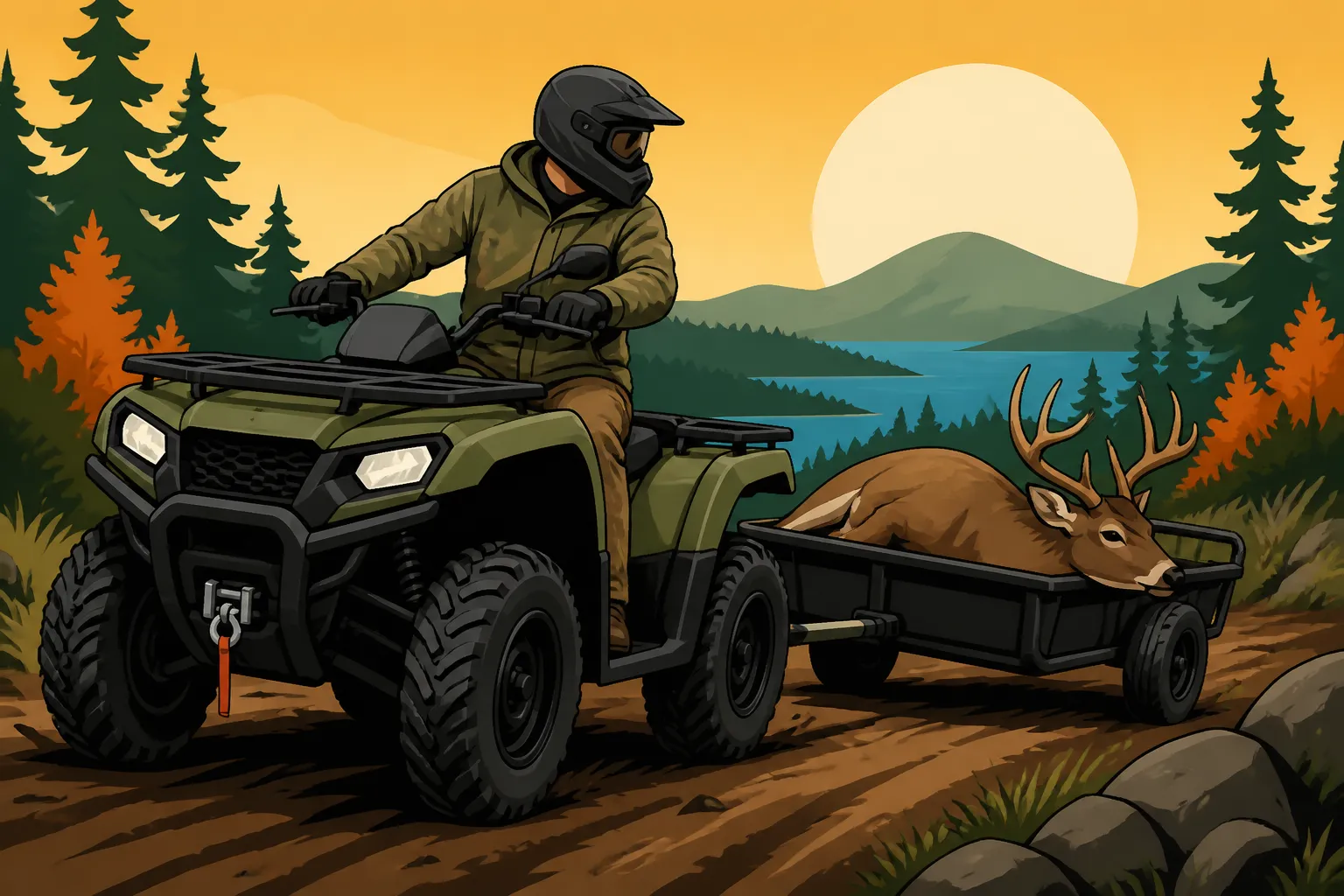
A deer can be awkward and heavy to move, especially when the closest legal access is a long way from the recovery site. In Maine, hauling it out by ATV takes more than a strong rack: you need permission to travel the route, a machine that can carry the load safely, and a plan for tagging and handling the deer.
Check the hunting and route rules first
An ATV can help move a legally harvested deer, but it does not give you permission to ride wherever the recovery is easiest. Before starting, separate two questions: are you allowed to use the ATV on this route, and are you meeting the current rules for the deer?
Confirm access for the whole trip
A route that looks open on a map may cross private land, a temporarily closed trail, or a road where ATV travel is not allowed. Confirm that you have permission or other legal access for every part of the trip, including the short connector between the harvest site and an established trail. A trail’s presence on a map does not establish that it is open to ATVs or that you have the right to use it.
In Maine, many ATV trails depend on landowner permission and can close when an owner withdraws access or trail conditions are poor. Check current local notices and ask the relevant landowner or trail club if access is unclear. The practical advice in Maine Landowner Permission Rules and Maine ATV Trail Closures Mid-Season is worth applying before you load the machine, not after you reach a closed gate.
Also check hunting-season restrictions and local rules that may affect ATV use. The rules for riding to a stand or reaching a hunting area are not necessarily the same as permission to travel off trail to retrieve an animal. See Maine ATV Rules During Hunting Season and Maine ATV Rules for Hunting Access for the issues to verify. Don’t use the ATV to pursue, harass, or unlawfully locate deer, and don’t assume that a recovery trip makes an otherwise prohibited route legal.
If the route involves a public way, use only a lawful ATV connection or designated route where applicable. An ATV registration is not a road-use permit. Maine ATV Rules on Public Ways explains why a registration sticker alone does not authorize travel along any road.
Take care of tagging and registration requirements
Follow current Maine hunting rules for tagging, transporting, and registering your deer. Attach the required tag as directed before moving the animal, and keep the tag and any required information with the deer during transport. Check the current instructions for when and where the deer must be registered, and what parts or evidence must remain with the carcass until then. Don’t rely on another hunter’s recollection of a deadline or procedure.
Nonresident hunters should check hunting requirements separately from ATV requirements. A valid hunting license or tag does not automatically cover ATV use, and an ATV registration does not replace hunting credentials. Visitors should verify the registration they need for the machine and trip length through Maine ATV Registration for Non-Residents before riding.
Choose a recovery method that fits the machine
There is no single best way to carry a deer. The right method depends on the ATV’s rated capacity, the terrain, the distance, and whether you can keep the carcass stable and clear of hot or moving parts. A compact game sled is useful in some conditions; a rack or cargo bed can work on others. Avoid improvising a setup that shifts the load or blocks your control of the machine.
| Method | Can work well when | Main drawbacks |
|---|---|---|
| Game sled or drag | The route is short, relatively smooth, and clear of obstacles | The sled may snag, tip, or add drag on steep or rough ground |
| Rear rack or cargo bed | The ATV has enough remaining rated capacity and a stable, secure loading area | A high or rear-heavy load can affect steering and stability |
| Front rack | The load is small enough to remain secure without blocking sightlines or controls | A bulky deer may obstruct the rider’s view or interfere with handling |
| Winch-assisted loading | The deer must be raised onto a bed or rack and the winch and anchor setup are suitable | A cable under tension can injure someone if it breaks or releases |
Check payload, not just towing capacity
The maximum payload shown in the owner’s manual includes the rider, passenger, accessories, and cargo. A machine that can tow a heavy trailer may still be unsuitable for carrying a heavy deer on its rack. Check the manual and do not exceed the manufacturer’s limits. If you cannot confirm the machine’s capacity, don’t treat a guess as a safe rating.
Weight placement matters as much as total weight. A load that sits high, hangs far behind the rear axle, or shifts to one side can make steering and braking harder. Keep the load as low and centered as the equipment allows. Don’t carry a passenger just because the ATV has a second seat if the added person and deer would exceed the rated capacity.
Select equipment for the route
A drag sled can be easier to handle than a rack load on a short, open route, but it can catch on stumps, rocks, brush, and sharp turns. A sled can also pull sideways on a slope. Choose a route that suits the equipment rather than forcing a loaded sled through terrain where it is likely to snag.
A rack or bed can keep the deer off the ground, but only if the load can be tied down without obstructing the rider, lights, exhaust, or controls. Use straps in good condition and secure the carcass so it cannot slide forward, backward, or sideways. Straps are for securing cargo, not for towing the ATV or replacing a proper recovery line.
For purchasing or comparing basic items such as tie-down straps or a game sled, a retailer such as Amazon may be one place to look. Check the product’s stated working limits, dimensions, and compatibility with your machine; a product listing is not a substitute for the ATV manufacturer’s payload limit.
Load and secure the deer before riding
A careful loading setup reduces the chance of damaging the machine, losing the carcass, or injuring someone. Make the loading area stable and keep bystanders clear of the ATV, winch cable, and any suspended or sliding load.
- Park on stable ground. Choose a level spot away from the edge of a steep slope, water, traffic, and loose footing. Set the brake and switch off the machine before preparing the load.
- Decide how the deer will be supported. Use a sled, cargo bed, rack, or suitable lifting aid that can hold the weight without bending or shifting. Do not rely on a homemade platform unless you can verify it is secure and suitable.
- Use help when the load is awkward. A deer can be difficult to lift and control even when its weight seems manageable. A second person can help guide the load, but should stay clear of pinch points and any tensioned cable.
- Use a winch cautiously. Follow the winch and ATV manuals. Use only an appropriate anchor, inspect the line, and keep people out of the line of pull. Never stand over, straddle, or place your hands near a loaded cable or a load that could roll.
- Secure the load in more than one direction. Attach suitable straps to secure points and check that the deer cannot slide, rotate, or bounce loose. Avoid tying to plastic bodywork, controls, or parts not designed to carry a load.
- Check the machine before moving. Confirm that the load does not cover lights, obstruct your view, touch the exhaust, interfere with steering or brakes, or prevent access to controls. Recheck strap tension after the first short, slow movement.
For a ground drag, attach the sled or drag to a suitable hitch point as directed by its manufacturer. Keep the connection short enough to reduce the risk of the sled striking the ATV on a descent, but do not improvise an attachment to the axle, rack, or another part not designed for towing. If the sled catches or the ATV becomes unstable, stop and reassess rather than using speed to pull through.
If the deer has been field dressed, keep it as clean as practical during the trip. Secure it so the carcass does not drag through mud, water, or debris unless the equipment is specifically designed for that use. Follow current hunting and meat-handling guidance for cooling and transporting the animal. Don’t delay necessary care simply to make the load look tidy.
Ride slowly and reassess the route
A loaded ATV behaves differently from an unloaded one. Extra weight can lengthen stopping distance, make the front end feel light, or reduce the machine’s ability to climb and turn. A sled adds resistance and can push from behind downhill. Plan to ride more slowly, leave extra room to stop, and avoid maneuvers that would be routine without cargo.
Avoid terrain that invites a rollover
Choose the smoothest legal route available, not the shortest one. Cross slopes cautiously and avoid steep sidehills, soft shoulders, deep mud, and abrupt drop-offs. Don’t attempt an obstacle if you cannot see where the machine and load will settle on the other side. If a trail is too narrow for the load or has a sharp turn beside a slope, stop and use another route or another recovery method.
Keep both hands available for control. Don’t try to hold the deer or manage a loose strap while operating. If a strap loosens, the sled catches, or the load shifts, stop in a safe place, secure the machine, and fix the problem before continuing.
Be especially careful at road crossings and on shared routes. Follow posted signs and applicable crossing rules, and expect other trail users, trucks, and people on foot. A deer or sled can extend behind the ATV, so allow room to turn and avoid blocking a travel way while loading or unloading.
Protect the carcass and the equipment
Check the load periodically, especially after bumps, turns, or a short initial run. Look for a strap that has loosened, a sled that is tracking crooked, or a load that is pressing against hot or moving parts. If the route is long, make stops where it is safe to do so.
For night travel, don’t assume that the ATV’s lights make a bulky load visible to others. Make sure the required lights remain unobstructed and follow applicable rules for night riding. If the deer or sled hides a light or creates a visibility hazard, change the setup or wait until you can travel safely and legally.
After reaching a safe location, unload on stable ground. Keep hands and feet away from the space beneath the carcass, and lower or slide the load under control rather than letting it drop. Clean the equipment and secure the carcass for transport in a way that follows hunting and food-handling requirements.
If the route or load is not safe
Stop if the ATV struggles to steer, climb, or brake, or if the load begins to shift. Don’t solve a capacity problem by adding speed, carrying a second person to balance the machine, or attaching the deer to an unsuitable part of the ATV. If the terrain is beyond the machine’s limits, consider a different route, a suitable hand sled, or help from another person with appropriate equipment and permission to use the route.
Before setting out, it can help to review What Maine ATV Registration Does Not Cover and Maine ATV Rules on Private Camp Roads if your recovery route crosses private property or a camp road. The key is to confirm access and operating rules first, then choose a method that fits the ATV and the terrain. A lawful, slower recovery is better than a quick route that puts the rider, carcass, or trail access at risk.
Disclaimer
This article is for general informational purposes only and does not constitute professional advice. Laws, prices and regulations vary by location and change over time. Consult a qualified professional for guidance on your specific situation.