Riding to a Remote Hunting Camp
A remote hunting camp can look close on a map and still be separated from your starting point by closed trails, private land, or roads where ATVs are not allowed. Before you ride in Maine, confirm that every part of the route is open to your machine and that your camp access is authorized. A little planning helps protect your trip, your safety, and future trail access.
Confirm the route is open all the way to camp
A route to a camp is only as usable as its least-permitted section. A marked trail may end before your destination, cross land with separate access rules, or connect to a public way where riding is restricted. Do not assume that a route shown on a map is open to ATVs simply because it appears continuous.
Start by identifying each part of the trip: the trail system, any connecting roads, the final approach to the camp, and any alternate route you might need. Check current notices from the local ATV club or other trail manager and ask the camp owner or land manager about the last segment. Trail conditions and access permissions can change, including during hunting season.
Maine riding routes often depend on permission to cross private property. A trail’s presence on a map does not necessarily mean that it is open today or that riders may leave the marked route. For background on why access can depend on private land, see Why 80 Percent of Maine Trails Sit on Private Land and Landowner Relations on Maine ATV Trails.
Before setting out, check:
- Whether the route is open to ATVs or UTVs of your machine’s size.
- Whether each connecting trail or road permits the type of vehicle you plan to ride.
- Whether a landowner has closed or limited access.
- Whether the trail manager has posted a seasonal closure or temporary detour.
- Whether the route reaches the camp, rather than only a nearby road or trail junction.
- Whether you need permission to park, unload, turn around, or leave supplies at the camp.
Where a section crosses private property, get permission from the person who controls access if it is not clearly authorized. Permission to reach a camp does not automatically mean permission to explore side trails, cut across a field, or use a different route on the return trip. If written permission is available, keep a copy with your trip details and follow any conditions the landowner gives you. The practical steps in Asking a Landowner for Permission to Ride can help you make that request clearly.
Treat signs, gates, barriers, and posted notices as important. Do not go around a gate or ride past a closure because the route looks passable. A closed section may protect a landowner’s property, prevent damage during poor conditions, or reflect a change in access. If the route is uncertain, stop and verify rather than guessing.
Check registration and the rules for your machine
Before a hunting trip, make sure your ATV or UTV is eligible to be used on the route you plan to ride. Registration requirements depend on the machine and circumstances, so confirm the current rules for your situation rather than relying on a friend’s sticker or an old registration. Registration is not permission to ride wherever you choose: it does not open private property or override trail closures.
If you are visiting Maine from another state or province, do not assume that your home registration automatically gives you access to Maine trails. Review the current requirements for out-of-state machines and riders. The site’s Maine ATV Rules for Hunting Access and What Maine Riders Need Before They Ride provide related starting points. For registration questions, see Maine ATV Registration for Non-Residents.
A UTV may have different access considerations from a smaller ATV. Width can matter on narrow trails, bridges, gates, and trail structures, and clubs may set limits for the routes they maintain. Check your machine’s dimensions against the route guidance instead of assuming that a trail open to ATVs will accommodate every side-by-side. Wide Side-by-Sides on Narrow Maine Trails explains why machine size deserves a separate check.
Public ways also require special care. An ATV-access route is not the same as general permission to ride any road, and road access may depend on how a town has designated and posted the route. A trail map alone may not show every local restriction. Review Maine ATV-Access Routes and How Towns Post Them and Riding an ATV on the Road in Maine if your trip uses a road connection. When in doubt, confirm the status with the town or route manager before riding it.
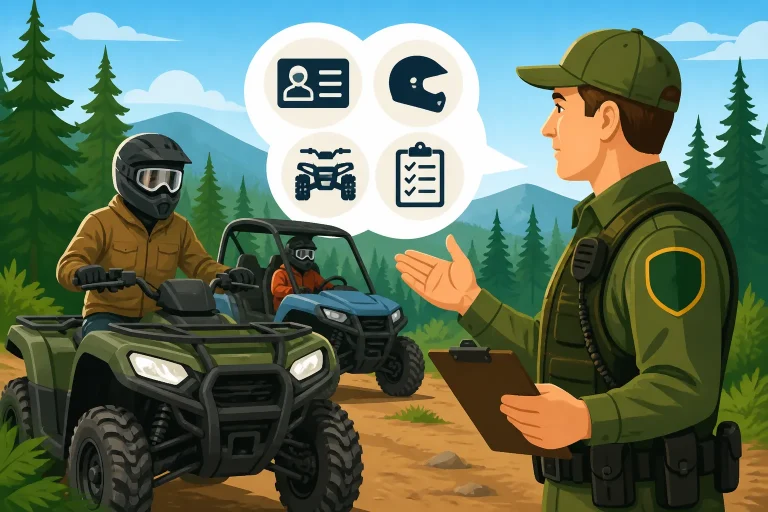
Keep the machine’s registration information and other required documents accessible. A remote trip is a poor time to find out that paperwork is missing, unreadable, or belongs to a different machine. Store documents in a protected place and carry a way to show relevant information if asked. The details in Do You Carry Registration Papers While Riding? can help you plan where to keep them.
| Route or machine issue | What to confirm before departure |
|---|---|
| Trail access | Current status, permitted vehicle types, and any closures or detours |
| Private land | Permission for the specific route and any conditions on access |
| Public way | Whether the road is designated for ATV use and what local limits apply |
| Registration | That the machine meets current Maine requirements for your circumstances |
| UTV width | That the full route, including gates and bridges, can accommodate the machine |
| Camp approach | That access reaches the camp and allows the planned parking or unloading |
Plan for hunting-season conditions and safe transport
A route that was open on a previous visit may be different during hunting season. Landowners may change access, trail managers may post temporary notices, and wet or damaged sections can become unsafe or impassable. Check the route close to your departure, and ask again if you are arriving after a delay or returning on a different day.
Plan your trip in daylight when possible. Remote routes can be difficult to follow after dark, especially where junctions are not obvious or cell service is weak. Build extra time into the schedule for slow sections, stops, and changes in trail conditions. Tell someone who is not riding with you which route you expect to use and when you plan to check in. Agree on what they should do if you do not make contact.
Do not count on a phone map as your only navigation tool. Download or print useful route information before leaving service, and carry a paper map or other backup you can read outdoors. A waterproof map sleeve can help protect a printed map; a basic one can be found at outdoor retailers or through Amazon. For more on backup navigation, see Navigating Trails Without Cell Service and Carrying a Paper Map in the Backcountry.
Think carefully about what you will carry and how it will be secured. A loaded machine may handle differently, and loose gear can shift on rough terrain. Keep essential items within reach without placing weight where it could interfere with the controls, wheels, or safe operation. Consider carrying:
- A charged phone and a backup power source, while recognizing that service may not be available.
- A map, route notes, and contact information for the camp owner or trail manager.
- Basic first-aid supplies and a flashlight or headlamp.
- Water, food, and clothing suitable for the weather and the time you may be outdoors.
- Tools and basic supplies suited to your machine.
- Any documents or equipment required for your trip and machine.
If you are carrying a firearm or other hunting equipment, check the applicable hunting and transport rules before the trip. Secure equipment so it cannot interfere with riding or fall from the machine, and handle firearms safely whenever you load, unload, or stop. Do not assume that an ATV route or camp permission changes the rules for hunting, firearm transport, or access to a hunting location. For route-related hunting considerations, see Maine ATV Rules During Hunting Season.
Ride at a speed that gives you enough time to respond to obstacles, other trail users, animals, and changing ground conditions. Stay on the authorized route, leave gates as you find them, and slow down near homes, camps, and other places where people may be present. Keep noise and dust down where practical. These habits matter especially during hunting season, when other people may be using the same woods for different reasons.
Use a practical check-in and return plan
A trip to a remote camp should have a clear turnaround plan, not just a destination. Decide where you can safely stop if a bridge, trail, or road is closed, and identify an alternate route only if it is confirmed open and permitted. Do not improvise by cutting across private land or taking an unmarked road.
Use this sequence before you leave:
- Confirm the destination access. Ask the camp owner or land manager whether the route is currently authorized, including the final approach and any parking or unloading area.
- Check the trail status. Look for current club, landowner, or municipal notices. Verify any road connections separately.
- Match the machine to the route. Confirm that your ATV or UTV is permitted and can fit through the narrowest sections.
- Review registration and equipment. Check the rules that apply to your machine and carry required documents and safety gear.
- Prepare navigation and communications. Save or print the route, carry a backup map, and tell someone your plan and expected return.
- Set a no-go rule. Agree in advance that you will turn back if a route is closed, access is unclear, or conditions make travel unsafe.
If riding with a group, choose a lead rider who knows the route and a sweep rider who can make sure nobody is left behind. Stop at safe places to regroup rather than scattering riders across unfamiliar junctions. Keep the group together where practical, and make sure everyone knows the plan if someone has a breakdown or needs to turn around.
A remote camp trip can also include walking, hunting, or other activity away from the machine. Park only where authorized, do not block a trail or gate, and avoid leaving gear where it could obstruct land management or other users. If your plans change and you need to stay longer, contact the person expecting you rather than relying on a later explanation.
The most reliable plan is the one that remains within confirmed access from start to finish. A current route check, clear landowner permission, suitable machine, and backup navigation can prevent a short ride to camp from becoming a trespass problem or a difficult recovery.
Disclaimer
This article is for general informational purposes only and does not constitute professional advice. Laws, prices and regulations vary by location and change over time. Consult a qualified professional for guidance on your specific situation.