Maine Helmet Law for Riders Over 18
There's often a lot of confusion, even among seasoned riders, about when an adult needs to wear a helmet while enjoying Maine's incredible ATV and UTV trails. It's easy to assume that once you're over 18, you're free from helmet rules, but Maine law has some specific nuances that can easily catch you off guard, especially when you venture beyond private land. This guide will walk you through exactly when and where a helmet is legally required for adult ATV and UTV operators and passengers in the Pine Tree State, ensuring you stay safe and on the right side of the law.
Maine's Core Helmet Law for Adult ATV Riders (18+)
Let's get straight to the heart of the matter. For adult ATV and UTV operators and passengers who are 18 years of age or older, Maine law generally grants you the freedom to choose whether or not to wear a helmet while riding on designated ATV trails or on private property. This is a common point of relief for many experienced riders who prefer the open air, but it's critical to understand that this freedom isn't absolute. There are very specific and common scenarios where that helmet absolutely needs to be strapped on, and missing those details can lead to fines or, more importantly, serious injury.
When a Helmet is Not Required for Adults
The general rule of thumb for adults (18 and over) is that if you are riding exclusively on a designated ATV trail, a trail that's part of Maine's vast public system or a club-maintained network, you are not legally required to wear a helmet. The same applies if you're riding solely on land that you own, or on private land where you have explicit permission to ride, and you're not interacting with any public ways.
For instance, if you're out for a weekend ride on the extensive [Aroostook County's 1,300-Mile Trail Network], cruising between towns like Presque Isle and Caribou, or exploring the loops around Jackman to Pittston Farm, and you stick purely to the marked trails, you're not legally obligated to wear a helmet. This is the scenario many riders envision when they think of "free riding." Similarly, if you're just using your quad to do some work around your camp in rural Maine, hauling firewood or clearing brush, and never leave your property, a helmet isn't mandated by state law. However, even in these situations, many seasoned riders, and certainly safety advocates, will tell you that a helmet is always a good idea. The trails can be unpredictable, and even a low-speed tip-over can result in a head injury.
Situations Where an Adult Helmet Is Required
This is where many adult riders get tripped up, and it's a critical distinction. Despite the general exemption, there are several key situations where an adult must wear a helmet while operating or riding an ATV or UTV in Maine. These rules are primarily concerned with safety when ATVs are interacting with public infrastructure or mixing with other forms of traffic, however briefly.
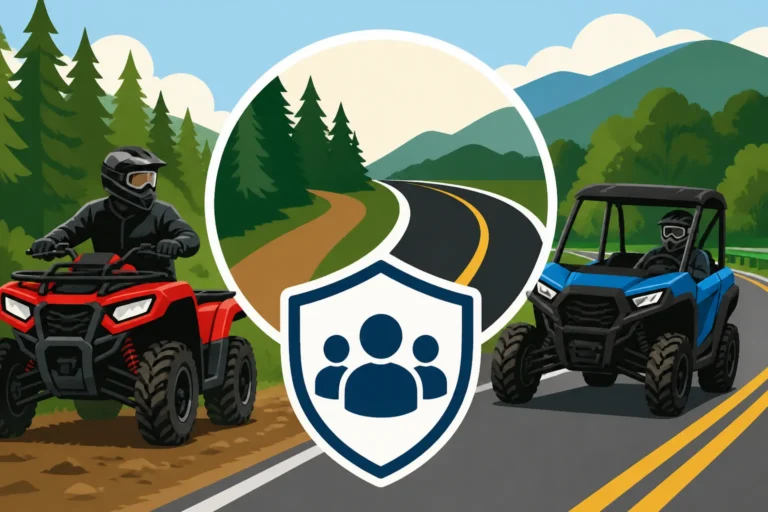
The most common requirement for adults to wear a helmet in Maine is when crossing or riding on a public way. This includes situations where you're simply trying to get from one section of a trail to another by briefly traversing a road. Maine law allows for ATVs to cross a public way by the most direct route, and also permits riding on the extreme right of certain public ways for a distance not exceeding [Maine's 500-Yard Limit on a Public Way], provided the town has designated it as an ATV access route. In any of these scenarios, whether you're just crossing a paved road to get to the next section of trail, or riding the shoulder of a gravel town road that's been designated an ATV access route to reach a gas station, you and any adult passengers are legally required to wear a helmet.
It's not just about crossing; if you're riding on any road designated as an [Maine ATV-Access Routes and How Towns Post Them], even if it's a dirt road in the middle of nowhere, and you're over 18, you need a helmet. This applies whether you're riding [Riding an ATV on the Road in Maine] to grab a bite to eat at a trailside restaurant or just commuting a short distance to access another part of the trail system. Furthermore, any time you're riding as a passenger and the operator is under 18, then the operator is required to wear a helmet (and the passenger would be too if under 18). While the adult passenger's own age still dictates their helmet requirement for their role, it's worth noting that strict helmet rules apply to youth riders. If you're a responsible adult, setting a good example and wearing a helmet, regardless of the law, is always wise.
Understanding "Designated Trails" vs. "Public Ways"
The distinction between a "designated ATV trail" and a "public way" is the cornerstone of understanding Maine's helmet laws for adults. Many riders assume that if a path is open to ATVs, it's all part of the same "trail system." However, legally, this isn't always the case, and this misunderstanding can lead to unexpected fines or, worse, accidents.
A "designated ATV trail" refers to paths specifically maintained and signed for ATV use, often on private land with landowner permission, or on public land like state parks or public reserved lands. These are the classic dirt tracks, old logging roads, and rail beds where you typically spend the bulk of your riding time. When you are solely on these types of trails, and you're an adult over 18, the helmet is optional under state law. However, a "public way" is essentially any road maintained by a municipality, county, or the state for public travel by motor vehicles, whether it's paved, gravel, or even just a well-maintained dirt road. When an ATV encounters or uses one of these public ways, even if it's for a very brief crossing, the rules shift dramatically. This is why you might see a sign indicating an ATV trail crossing a paved road. While the trail continues on the other side, that brief interaction with the public way triggers the helmet requirement for all riders, regardless of age. It's a critical safety measure because you're now in an environment with cars, trucks, and other road traffic, where the risk profile changes considerably. Knowing your route and where those trail-to-road transitions occur is vital for compliance and safety.
The "Why" Behind Maine's Helmet Laws (Even for Adults)
You might wonder why, if adults are generally allowed to choose, the law imposes helmet requirements in certain situations. It's not about arbitrary rules; it's deeply rooted in safety, risk mitigation, and the unique challenges ATVs face when interacting with the broader world of public roadways. While a helmet might feel restrictive sometimes, its primary purpose is to protect your most vital organ.
Safety and Risk Mitigation on the Trails and Roads
The undeniable truth is that ATV riding, while exhilarating, carries inherent risks. Accidents can happen in a split second, whether due to unexpected terrain, operator error, or collisions with obstacles or other vehicles. Head injuries are among the most devastating outcomes of ATV accidents, often leading to long-term disabilities or fatalities. Even experienced riders can misjudge a turn, hit an unseen rock, or have an unexpected mechanical issue that throws them from their machine. When you're on a trail, impacts typically occur at lower speeds with softer surroundings, but once you introduce pavement, vehicles, and higher speeds, the stakes dramatically increase.
That's precisely why Maine's helmet law for adults focuses on public ways. When you're crossing a road, even for a few seconds, you're exposed to fast-moving traffic, hard surfaces, and other unpredictable factors. A helmet provides crucial protection against blunt force trauma, abrasions, and concussions. It can mean the difference between walking away with a headache and facing a life-altering brain injury. Think of it as a small inconvenience for a massive safety benefit. Manufacturers like SuperATV also emphasize safety gear, not just performance parts, because they understand the realities of off-road riding. They know that even the most advanced machines can't prevent every mishap, and personal protective equipment is your last line of defense. [Maine ATV Safety Course Requirements] also reinforce this culture of safety.
Liability and Insurance Considerations
Beyond the immediate physical safety, there's a practical side to helmet use that involves liability and insurance. While Maine law doesn't require ATV insurance for trail riding, it's highly recommended, and certainly for road-legal UTVs. In the unfortunate event of an accident, particularly one involving an injury on a public way, your helmet use (or lack thereof) can significantly impact liability assessments and insurance claims.
If you are involved in an accident while operating an ATV on a public way without a legally required helmet, you could face legal repercussions, including fines for violating the law. More critically, if you sustain a head injury, an insurance company or a court might argue that your failure to wear a helmet contributed to the severity of your injuries, potentially reducing any compensation you might otherwise be entitled to. It adds another layer of complexity and potential financial burden to an already stressful situation. Wearing a helmet when required is not just about avoiding a ticket; it's about protecting yourself legally and financially, in addition to physically. It demonstrates responsible riding and adherence to safety standards, which can be invaluable if you ever find yourself in a claims process or legal dispute.
What Makes a Helmet "Legal" in Maine?
It's not enough to simply put any helmet on your head when the law requires it. For a helmet to be considered "legal" and provide effective protection in Maine, it must meet certain safety standards. This ensures that the helmet is actually designed to absorb impact and protect your skull, rather than just being a decorative item. Understanding these standards is key to making a smart purchase.
Understanding DOT and ANSI Standards
When you're shopping for an ATV helmet, you'll commonly see references to "DOT approved" or "ANSI certified." These aren't just marketing terms; they refer to rigorous testing standards that helmets must pass to be deemed safe for use on public roads and trails.
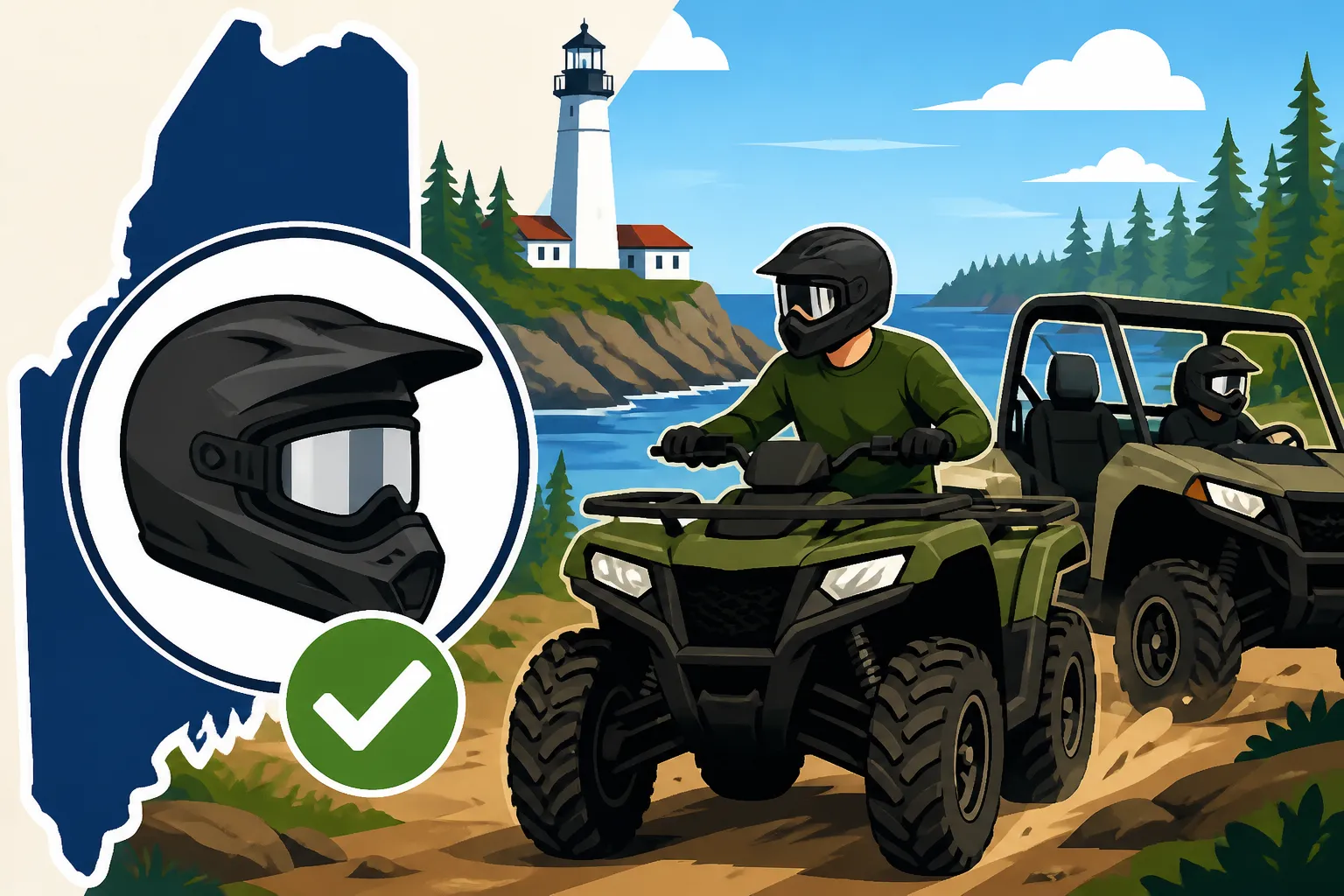
The DOT (Department of Transportation) certification is arguably the most important for ATV riders, especially when you're on public ways. This certification, indicated by a sticker on the back of the helmet, means the helmet has met the minimum safety standards set by the U.S. government for motor vehicle helmets. These standards test for impact attenuation (how much energy the helmet can absorb), penetration resistance, and retention system effectiveness (how well the chin strap stays fastened). If your helmet doesn't have a DOT sticker, it's not considered legal for use where a helmet is required in Maine, regardless of how sturdy it looks or how much you paid for it.
The ANSI (American National Standards Institute) standard, specifically ANSI Z90.1, also sets safety requirements for helmets. While DOT is the primary legal standard for road use, ANSI certification often signifies a helmet that has undergone additional, voluntary testing beyond the DOT minimums. Many high-quality ATV helmets will meet both DOT and ANSI standards, offering an extra layer of reassurance. When you're looking to buy, always check for the DOT sticker. You can dive deeper into these certifications by reading [DOT vs ANSI Helmet Standards for Riders] to understand the nuances of each.
Helmet Fit, Type, and Essential Accessories
A helmet, regardless of its certification, can only do its job effectively if it fits properly. A helmet that's too loose can shift during an impact, failing to protect your head, while one that's too tight can be uncomfortable and distracting. When trying on a helmet, it should feel snug all around your head, without painful pressure points. It shouldn't move freely when you shake your head, but it also shouldn't feel like your head is being squeezed.
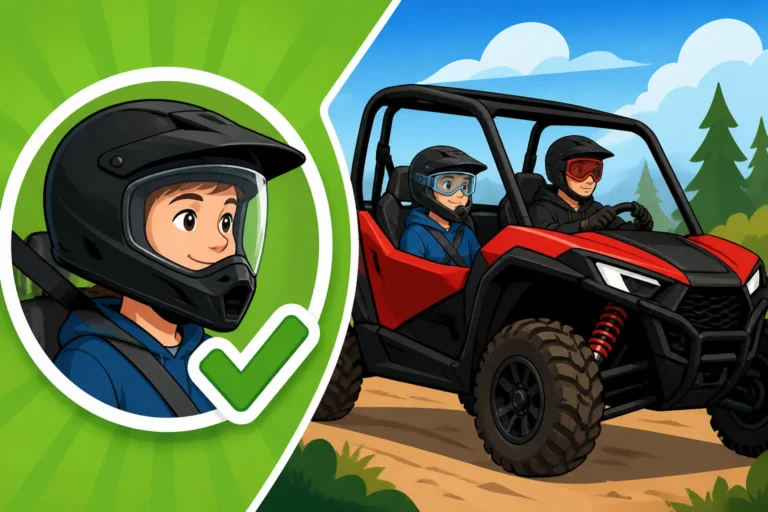
There are several types of helmets suitable for ATV riding. Full-face helmets offer the most comprehensive protection, covering your entire head and face, which is especially beneficial for high-speed riding or in dusty/muddy conditions. Open-face helmets provide more ventilation but leave your face exposed, requiring separate eye protection. Modular helmets offer a compromise, with a chin bar that can be flipped up. For ATV riding, particularly in Maine's varied terrain, a full-face or a sturdy open-face helmet combined with proper [Eye Protection on a Road Ride] is generally recommended. Companies like SuperATV offer a range of accessories, including goggles and face shields, that complement your helmet choice. Always prioritize visibility and protection from debris. Remember, [Buying a Helmet That Meets the Standard] is the first step; ensuring it fits correctly and is worn with appropriate accessories is the next crucial step in maximizing your safety on the trails and roads.
Consequences of Not Following the Maine Helmet Law
Ignoring Maine's helmet laws for adult ATV riders isn't just a minor oversight; it can have significant legal, financial, and personal repercussions. The Maine Warden Service, along with local law enforcement, actively patrols trails and roads to ensure compliance, and they take these rules seriously for everyone's safety.
Fines and Penalties for Non-Compliance
If a Maine Warden or other law enforcement officer stops you while you're operating an ATV on a public way (crossing or riding on an access route) without a legally required helmet, you can expect to receive a citation. The specific fine amount can vary, but it's generally a civil violation with a monetary penalty. It might seem like a small amount, but it’s an unnecessary expense that could easily be avoided by simply wearing the correct gear.
Beyond the immediate fine, repeated violations could lead to more severe penalties, though this is less common for first-time helmet offenses. However, any citation goes on your record and can be a hassle to deal with, requiring court appearances or mail-in payments. The Maine Warden Service conducts regular [Maine Warden Service ATV Patrols] to ensure riders are following all regulations, not just helmet laws. Getting caught breaking the rules, even a seemingly minor one, can put a damper on your whole riding experience and leave you feeling frustrated. You can get a sense of common infractions by looking at [Fines Maine Wardens Write Most Often].
Personal Responsibility Beyond the Law
While legal penalties are a deterrent, the most significant consequence of not wearing a helmet when needed goes far beyond any fine. It boils down to personal responsibility for your own safety and well-being. Even in situations where the law doesn't strictly mandate a helmet for adults, choosing to ride without one means you're intentionally foregoing critical protection.
Consider this: you're out riding with friends, enjoying a beautiful fall day on the trails, and suddenly, an unexpected rut or a patch of loose gravel sends your ATV into a roll. If you're wearing a properly fitted, DOT-approved helmet, you have a much higher chance of walking away from that incident with minor injuries, or at least without a severe head trauma. Without it, the outcome could be catastrophic. It's easy to think "it won't happen to me," but accidents are, by definition, unexpected. Many experienced riders choose to wear helmets consistently, regardless of the legal requirement, simply because they understand the inherent risks of ATV riding. Protecting yourself is not just about avoiding a fine; it's about being able to continue enjoying the trails for years to come, and more importantly, being there for your loved ones. Making that choice to protect your head is perhaps the most important personal responsibility an ATV rider can embrace.
| Location/Activity | Helmet Required for Adults (18+) | Notes |
|---|---|---|
| Designated ATV Trails (Private) | Generally No | Unless specific club rules apply or special events. |
| Designated ATV Trails (Public) | Generally No | State-sanctioned trails. |
| Crossing a Public Way (Road) | Yes | Even if just 500 yards or less. |
| Riding on a Public Way | Yes | If the town allows ATV access on specific roads. |
| Riding on Your Own Land | No | But always recommended for safety. |
| Passenger Under 18 | Yes (for passenger) | Driver must still follow their own age rules. |
| Commercial/Guided Tours | Often Yes | Many outfitters require helmets for all riders. |
Disclaimer
This article is for general informational purposes only and does not constitute professional advice. Laws, prices and regulations vary by location and change over time. Consult a qualified professional for guidance on your specific situation.