New Brunswick Registrations Honored in Maine
A New Brunswick ATV registration can be recognized in Maine, but that does not mean an entire trip is automatically covered. The key is understanding the limited reciprocity arrangement, what documents to carry, and which rules still apply once you reach Maine trails. This guide explains how to plan around the three-day exception and what to check before riding.
What Maine Recognizes About a New Brunswick Registration
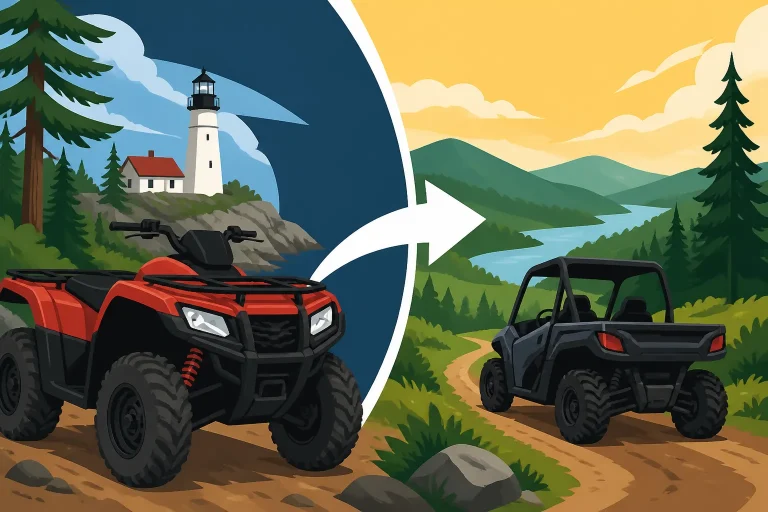
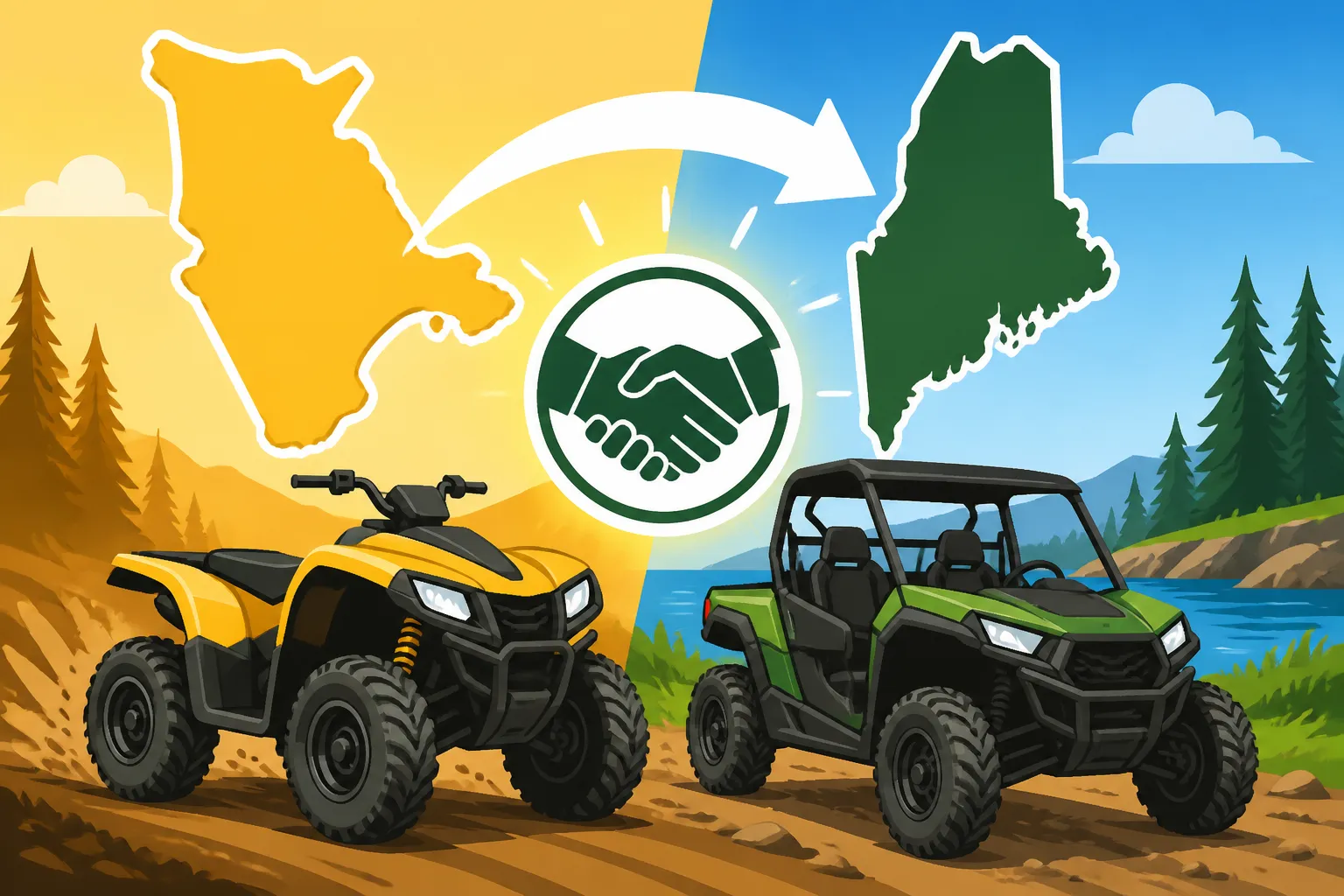
Maine has a limited arrangement that recognizes valid New Brunswick ATV registrations for qualifying riders. It is a narrow exception, not unrestricted reciprocity: having a New Brunswick registration does not give every visitor permission to ride in Maine for an unlimited stay.
In practical terms, eligible New Brunswick riders may be able to use their properly registered ATV or UTV in Maine for a limited three-day period without obtaining a Maine registration. The details of eligibility and how the days are counted matter. Before traveling, confirm the current requirements with Maine’s official ATV registration authority and, if needed, the relevant New Brunswick authority. In particular, check whether the rider must be a New Brunswick resident, how the qualifying registration must be displayed, and how Maine counts the permitted days.
The arrangement is different from buying a Maine nonresident registration. It is also different from having permission to ride on any particular property or trail. A machine may qualify for the registration exception while its rider still lacks permission to use a trail, private road or other land.
| Your situation | What to check | Practical next step |
|---|---|---|
| You live in New Brunswick and have a current ATV registration | Whether you and your machine qualify for Maine’s limited arrangement, and how the permitted days are counted | Confirm the current rule before your trip and carry proof of the New Brunswick registration |
| You live elsewhere in Canada but have a New Brunswick registration | Whether eligibility depends on the rider’s residence as well as the machine’s registration | Do not assume the registration alone qualifies you; ask Maine’s registration authority |
| You plan to ride in Maine beyond the permitted period | Which Maine nonresident registration fits your trip | Compare the available options in Maine Non-Resident ATV Registration Options |
| You are visiting for about a week | Whether the New Brunswick exception covers the full trip | Review Maine Non-Resident Seven-Day ATV Registration |
| You have an annual Maine visit or return trip planned | Whether an annual nonresident registration is the more suitable option | Check Maine Non-Resident Annual ATV Registration |
| You are riding a UTV or side-by-side | Whether the same registration treatment applies to your machine and whether trail size limits affect your route | Review Maine UTV Registration and How It Differs and check trail-specific restrictions |
A useful way to think about reciprocity is that Maine is recognizing a qualifying registration for a defined purpose and period. It is not transferring New Brunswick’s entire set of rules to Maine. Once you are riding in Maine, Maine’s operating laws and the landowner’s or trail manager’s access rules still matter.
Do not rely on a sticker alone to establish that you qualify. If there is a question about the rider’s residency, the registration’s status, or the permitted period, carry paperwork that makes your situation easy to explain. If your travel dates are close to the limit, get an answer before you set out rather than trying to resolve the issue at a trailhead.
Who Should Verify Eligibility Before Riding
The most straightforward case is a New Brunswick resident operating a machine with a current, valid New Brunswick registration. Even then, confirm that the registration is current for the dates of the trip and that your planned Maine riding fits within the limited period.
Other situations can be less clear. For example, you might live in another province but have a machine registered in New Brunswick, or you might borrow a relative’s registered ATV. The existence of a New Brunswick registration does not necessarily settle whether the person operating the machine qualifies for the exception. Confirm whether eligibility follows the registration, the rider’s residence, or both.
It is also worth checking the machine category. ATV rules and paperwork can differ for a UTV or side-by-side, and trail access may depend on the vehicle’s width or other restrictions. A registration that is accepted for the limited period does not guarantee that the machine will fit on every route. If you are bringing a side-by-side, check the specific trail system before you unload.
If you cannot confirm that the exception applies to your situation, the safer planning choice is to arrange the appropriate Maine nonresident registration before riding. Maine offers nonresident options for different trip lengths, but the right one depends on your dates and plans. Compare the current choices in Seven-Day vs Annual Maine ATV Registration and confirm the rules and costs with the provider before purchase. Fees and requirements can change, so use current official information rather than relying on an old receipt, forum post or someone else’s recollection.
Questions to settle before departure
Make sure you can answer these questions:
- Is the New Brunswick registration current and issued for the machine you are bringing?
- Does the limited Maine arrangement apply to you as the rider, given where you live?
- How does Maine count the permitted three-day period?
- Do your planned riding dates fit inside that period?
- If your trip changes or runs longer, how will you obtain the required Maine registration?
- Are you riding an ATV or a UTV, and does the route allow that type and size of machine?
- Do you have permission to use each trail or private connection on your route?
If you are unsure about any of the first five questions, contact the official registration authority before the trip. If you are uncertain about trail access, contact the club, landowner or local trail manager responsible for that route. These are separate questions, and one answer does not replace the other.
A New Brunswick registration also should not be confused with a Maine registration confirmation or a trail permit. Each document has a different purpose. If you buy a Maine registration as a fallback, keep the confirmation and any other required paperwork accessible, and check whether the registration is effective before you begin riding. Riding in Maine on the Confirmation Page explains why a receipt or confirmation should not be treated as a substitute for understanding the applicable requirements.
What to Carry and How to Prepare the Machine
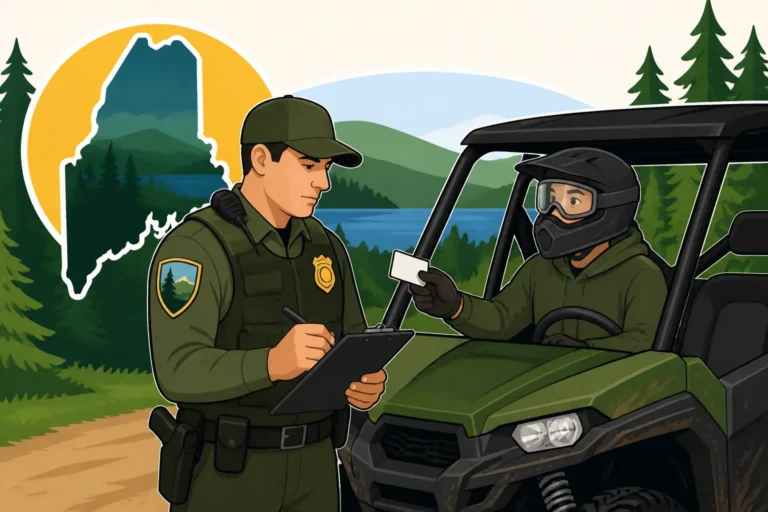
Carry proof of the New Brunswick registration in a form you can show if asked. The document should be legible and match the machine you are operating. If the registration is kept electronically, make sure you can open it without relying on a strong cell signal. A downloaded copy or printed backup can be useful in remote areas.
It is sensible to bring identification as well, especially if eligibility for the exception may depend on your residence. Your goal is not to carry a folder of every document you have ever received; it is to be able to explain who you are, what machine you are operating and why you believe the registration exception applies.
Before loading, compare the information on the registration with the machine’s identifying details. Check that the VIN is readable and that the paperwork refers to the correct vehicle. If you have recently bought or borrowed the ATV, make sure you can explain the connection between the registration and the machine. For a used purchase, Proof of Ownership for a Maine ATV Registration offers useful background on why clear ownership paperwork matters, even when you are not applying for a Maine registration.
A short document checklist can help:
- Current New Brunswick registration for the machine
- Identification that supports your eligibility, if residence is relevant
- Proof of purchase or permission to use the machine, if you are not the registered owner
- Any Maine registration paperwork if you have obtained a Maine nonresident registration
- Insurance information, if applicable to your situation or required for the type of use
- A trail map and contact information for the trail organization or land manager
Keep the paperwork protected from mud and rain, but reachable. A waterproof pouch or document holder can help keep a paper copy readable. If you shop for one on Amazon, choose something that can be secured and opened easily without distracting you while riding. Avoid putting important paperwork somewhere that requires unloading gear or removing tools to reach it.
Registration is only one part of being ready. Check that the machine’s own registration decal or markings are displayed as required, and that they are visible and in good condition. Do not assume a New Brunswick decal should be placed in the same location as a Maine decal. Follow the instructions that apply to the New Brunswick registration and the machine, and confirm any Maine-specific display requirement with the appropriate authority. For Maine decals, Where to Stick a Maine ATV Registration Decal covers placement.
If you have also obtained a Maine registration, keep its paperwork and decal information separate from the New Brunswick documents. That avoids a confusing situation where you show a document that does not match the registration marking on the machine. A compact folder or waterproof pouch can be useful; Amazon is one possible place to look, but durability and secure storage matter more than brand.
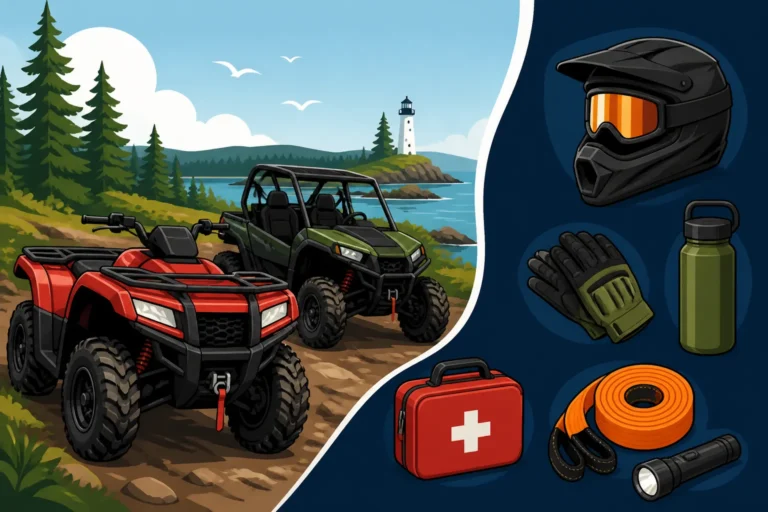
Finally, confirm that the machine is safe and suitable for the route. Check tires, brakes, lights, steering, fuel and basic recovery equipment. A vehicle that is legally registered can still be unsafe or inappropriate for a narrow, wet or remote trail.
Reciprocity Does Not Replace Maine Riding Rules
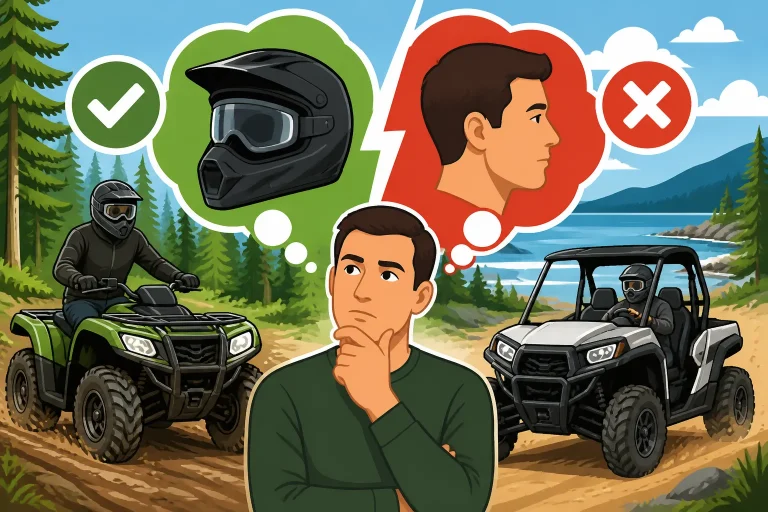
Once you ride in Maine, follow Maine’s operating laws, even if your machine is registered in New Brunswick. Reciprocity concerns recognition of the registration for a limited period; it does not exempt you from Maine’s rules about helmets, passengers, road crossings, speed, alcohol, equipment or youth riders.
The exact requirements can depend on the rider’s age, the kind of machine, where it is being operated and whether the route includes a public way. Do not assume that a rule you follow at home is identical in Maine. Before a trip, review the relevant rules for the people and routes in your group. Maine ATV Rules for Riders Under 16 on Roads is useful if a young person may ride or cross a public way, and Maine Helmet Requirements by Age covers helmet requirements by age.
Trail access is a separate issue from registration. Many Maine trails depend on permission from landowners and are managed by local clubs or other organizations. A machine can have valid registration and still be prohibited from a particular road or trail. Conditions can change, including seasonal openings, temporary closures and landowner decisions. Confirm that your route is open and that your machine is allowed before setting out.
That distinction is especially important if your route uses a mix of club trails, private roads and public ways. Do not assume that a marked trail automatically authorizes travel on every connecting road. Ask the local club or land manager if a connection is unclear, and obey signs and closures. For more on how this access works, see Maine Landowner Permission Rules and Maine ATV-Access Routes and How Towns Post Them.
A New Brunswick registration also does not make an ATV or UTV street legal. Riding on a road is governed by separate rules, and access may be limited to designated routes or specific crossings. Before planning a ride that uses a public way, review Riding an ATV on the Road in Maine. If a route crosses a road, do not assume you may travel along it afterward.
Insurance deserves its own check. Registration recognition is not proof of insurance, and it does not guarantee that a policy issued in New Brunswick covers every activity in Maine. Contact your insurer before the trip and ask specifically about riding in Maine, trail use, road sections, passengers and any restrictions on the machine. Carry the appropriate insurance information if your policy or circumstances call for it. For a Maine-focused overview, see Maine ATV Insurance and When You Need It.
If you are riding with a group, make sure every operator understands the rules and the route. A visitor may be familiar with the lead rider’s machine but not know that a narrow trail or town road has different conditions. Agree on stopping points, keep the group together where practical and do not pressure anyone to ride a section they consider unsafe.
Planning a Trip That May Last Longer Than Three Days
The simplest way to avoid a registration problem is to plan your dates before you leave home. Write down when you expect to begin riding in Maine and when you expect to finish. Then confirm how the limited period applies to those dates. Do not rely on a casual interpretation of “three days,” particularly if your trip begins late in the day, includes a day without riding, or changes after arrival.
If the trip may run longer, arrange the appropriate Maine registration in advance rather than assuming you can extend the New Brunswick exception. Check what information the application requires, whether you can complete it online or in person, and how you will receive or display proof. Rules for first-time registration and renewal can differ, so read the instructions for the option you are purchasing.
A Maine nonresident registration may be a better fit if you plan to ride beyond the limited exception. The available options are designed for different travel patterns; compare them based on your actual dates instead of choosing only by the time you expect to spend on the trails. A seven-day option may suit a short visit, while an annual option may make sense for repeated trips. Confirm current terms, prices and eligibility directly with the official provider. Related guides include Maine Non-Resident Seven-Day ATV Registration and Maine Non-Resident Annual ATV Registration.
If you are already in Maine and realize your plans have changed, stop and resolve the registration question before continuing to ride. Ask the official authority what applies to your circumstances. Do not assume that a receipt for a purchase started online, an expired registration, a photograph of a sticker or a friend’s registration covers your machine. If you buy a Maine registration, make sure you understand when it becomes effective and what proof you must carry. Maine ATV Registration Confirmation for Immediate Riding can help you think through the difference between applying, receiving confirmation and having the required proof available.
Build some flexibility into your travel plan. Weather, breakdowns, trail closures or a change in lodging can add days. If your planned stay is close to the permitted limit, consider whether getting a Maine nonresident registration from the outset is simpler than trying to stay within a tight window. The additional paperwork may be a worthwhile trade-off for a longer or less predictable trip, but check current terms before deciding.
For paper copies of maps or confirmation documents, a secure waterproof pouch can help. If you use a phone for navigation, save maps for offline use before leaving town and bring a backup plan for poor reception. A printed trail map, kept with the registration documents but protected from moisture, can be useful when a phone battery is low. Amazon may offer map cases or pouches, but choose equipment that stays secured on the machine and does not interfere with controls or safe riding.
Before the first ride, do one last check:
- Your New Brunswick registration is current and matches the machine.
- You have confirmed that the limited Maine exception applies to your rider and trip.
- You know how the permitted days are counted.
- You have a plan for obtaining a Maine registration if the trip extends.
- The route is open and allows your ATV or UTV.
- You have landowner or trail access where required.
- Riders know Maine’s applicable safety and operating rules.
- Your insurer has confirmed any relevant coverage for riding in Maine.
New Brunswick registrations can be honored in Maine under a limited arrangement, but the safe planning assumption is not “my registration works everywhere.” Treat reciprocity as a short, specific exception. Confirm eligibility, track the days carefully, and keep registration, insurance and trail-access questions separate. That preparation can prevent an otherwise good trip from turning into a paperwork problem.
Disclaimer
This article is for general informational purposes only and does not constitute professional advice. Laws, prices and regulations vary by location and change over time. Consult a qualified professional for guidance on your specific situation.