Where to Take a Maine ATV Safety Course
Finding an ATV safety course in Maine can be harder than knowing one is needed: classes may be offered locally, fill quickly, or appear only at certain times of year. Start with Maine’s official safety-course listings, then confirm that a class is approved for your rider and ask what it takes to complete it and receive a certificate.
Start with Maine IF&W’s official course information
The best first stop is the Maine Department of Inland Fisheries & Wildlife, commonly called Maine IF&W. Look for its ATV safety education information and current course listings. The department is the source to check for courses recognized by the state, current requirements, and instructions for finding or registering for a class.
Course dates and locations can change. A class that was offered last season may not be available now, and a listing can fill before its scheduled date. Search the official course information close to when you plan to enroll rather than relying on an old calendar, social media post, or directory page. If the online listing does not answer a question, contact the department using its current contact information.
A practical search process is:
- Open Maine IF&W’s current ATV safety course information.
- Check whether the course is required for the rider, based on their age and situation.
- Search the available listings by location, date, or course format.
- Confirm directly with the instructor or course contact that the class is still scheduled and has space.
- Ask whether the course satisfies Maine’s requirement and what documentation the rider receives.
- Keep the completion record after the course.
The requirement can depend on details such as the rider’s age and the circumstances in which they operate. Don’t assume that a course taken for another activity, a general online safety class, or a course from another state automatically meets Maine’s rules. Check Maine ATV Safety Course Requirements for the requirement questions to resolve before you book.
If you are helping a young rider, check the age-specific rules before choosing a date. The course and supervision rules may matter alongside age and machine restrictions. Maine ATV Safety Course for Riders 10 to 15 covers that part of planning.
Where to look for classes near you
Maine ATV courses may be offered in different communities by instructors and organizations involved in safety education. The exact mix of locations depends on who is teaching, when a class is scheduled, and whether enough participants register. This means there may not be a regular course in every town, or one available on the particular weekend you want.
Start with the official listings, then use local contacts as a way to find out about possible upcoming classes. A nearby ATV club, town recreation department, community organization, or outdoor group may know whether an approved course is planned locally. Treat these as leads, not proof that a course is currently available or recognized. Before registering, verify the class through Maine IF&W or confirm its approval with the course provider.
| Where to check | What it can help you find | What to confirm |
|---|---|---|
| Maine IF&W course information | Current course details and official guidance | That the listing is current and fits the rider |
| Listed instructor or course contact | Available seats, meeting place, and class instructions | Whether the class is still scheduled and recognized |
| Local ATV club | Possible local classes or instructor contacts | Whether the course is approved, not just club training |
| Town recreation or community program | A class planned for local residents or youth | Registration rules, age range, and certificate details |
| Online course provider | A possible remote option | Whether Maine accepts that exact course for the rider |
A course can be close geographically but still be a poor fit if it is full, does not include the needed instruction, or is not accepted for the rider’s situation. Confirm the course details before paying or making travel plans. For a clearer picture of what an in-person class involves, see ATV Safety Courses Held in Person.
If you are looking in a particular county or town, ask local organizations whether they have an upcoming class or know an instructor who is planning one. Do not rely on a listing that has no current date or contact person. A short call or email can establish whether the class is actually happening and what steps are needed to reserve a place.
In-person classes and online options
A course may be offered in person, remotely, or through a format that combines more than one kind of instruction. Do not assume that every provider’s online class is accepted in Maine simply because it covers ATV safety. Confirm that the specific course and format satisfy the current state requirement before enrolling.
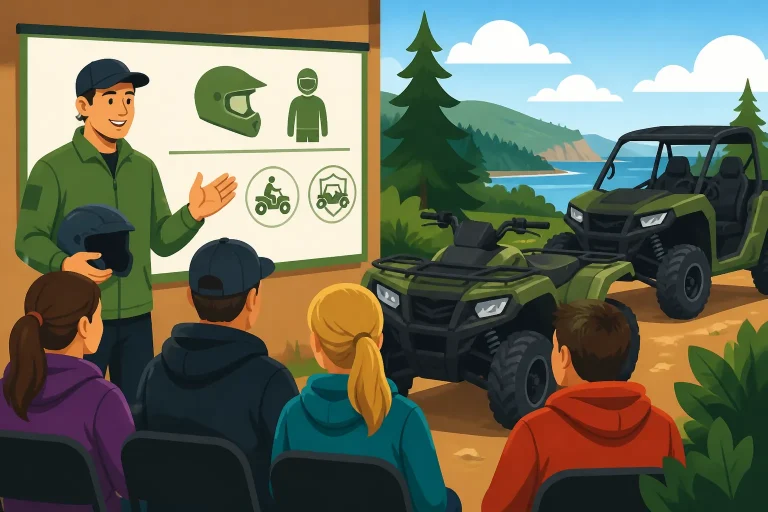
In-person instruction can be useful when a rider learns best by asking questions and talking through examples with an instructor. It also gives families a chance to hear how safe decisions apply to real riding situations, such as handling a machine, choosing appropriate terrain, and recognizing risks. The class location may be a community venue rather than an ATV trail, so ask what the instruction includes and whether anything needs to be brought.
An online option can be more convenient when travel or scheduling is difficult, but convenience is only useful if the course is accepted for the rider. Before registering, check the provider’s identity, the course’s Maine approval, any age restrictions, and what proof of completion is issued. Taking the Maine ATV Safety Course Online explains the questions to ask when considering a remote class.
When comparing formats, ask:
- Is this course currently recognized for Maine ATV safety requirements?
- Is it suitable for the rider’s age?
- Does the course have an in-person, online, or blended format?
- Is there a final test, practical portion, or other completion step?
- How is the completion certificate provided?
- Who should be contacted if the certificate is delayed or contains an error?
Take care with search results that advertise an “ATV safety certificate” without clearly identifying whether Maine accepts it. A certificate from a commercial provider is not necessarily interchangeable with a state-recognized course. If the provider’s description is vague, pause and confirm with Maine IF&W before paying.
Registration, cost, timing, and proof of completion
Course arrangements differ, so check the current registration process and any charges with the provider. Do not rely on an old fee or a past course schedule: class costs, materials, payment methods, and availability can change. For more detail on budgeting, see Maine ATV Safety Course Cost. To estimate the time commitment, check How Long the ATV Safety Course Takes.
When you contact a course provider, get the practical details in one conversation:
- The exact date, start time, and expected end time
- The full location, including any room or entrance instructions
- Whether a parent or guardian must register or attend with a youth
- Any required identification, forms, supplies, or pre-course work
- Whether there is a fee and how payment is handled
- What the rider must do to pass or complete the course
- How the certificate or completion record will be delivered
Make sure the rider’s name and other identifying details are entered correctly. A misspelled name or incomplete registration information can make it harder to locate a record later. Keep the confirmation message and course details until the certificate arrives.
Do not plan a ride on the assumption that signing up for a class is the same as completing it. If the rider needs proof of completion, wait until the class is finished and the required record has been issued. If a certificate does not arrive, contact the course provider first. If the provider cannot resolve the issue, ask Maine IF&W how to verify completion or replace missing proof. Replacing a Lost Safety Certificate may help if the document is misplaced after it has been issued.
A course certificate also does not replace other riding requirements. Registration, trail access, age restrictions, supervision, and landowner permission are separate matters. Before riding, check What Maine Riders Need Before They Ride and confirm the rules that apply to the machine and route you intend to use.
How to choose a course and prepare
The closest available class is not always the most suitable one. Choose a course that is recognized, appropriate for the rider, and realistic to attend from start to finish. If you are arranging instruction for a child, make sure the course’s age range and registration process are clear before you reserve a seat.
Use this checklist before committing:
- Verify recognition. Confirm through Maine IF&W or the listed provider that the specific course meets the relevant Maine requirement.
- Check the rider’s eligibility. Ask whether the course is open to the rider’s age group and whether a parent or guardian has to participate.
- Confirm the format. Find out if the class is in person, online, or blended, and whether any part must be completed at a particular time or place.
- Get the schedule in writing. Save the date, address, start time, and any arrival instructions.
- Ask about missed sessions. If the course has multiple parts, learn what happens if the rider cannot attend one.
- Clarify completion. Ask what counts as passing and how the rider receives proof.
- Keep the record. Save the certificate and any confirmation in a place you can access when planning future rides.
If the class is full, ask whether there is a waitlist or another upcoming session. You can also check whether a different nearby location has an available course. Avoid enrolling in multiple courses at once unless the providers confirm that doing so is allowed and necessary; it can create duplicate records or unnecessary expense.
For young riders, make the course part of a wider preparation plan. Talk about supervision, safe riding choices, and why a machine should match the rider’s abilities. A safety certificate is not a substitute for adult judgment or practice in a controlled setting. It also does not grant permission to use private trails or public land. Check land access separately through Maine Landowner Permission Rules.
If the rider will be visiting Maine from another state, ask whether their existing safety certificate is accepted before scheduling a second course. Requirements and certificate recognition can differ, so check Out-of-State Safety Certificates Accepted in Maine rather than assuming that a certificate from elsewhere automatically qualifies.
Frequently Asked Questions
How do I find an ATV safety course near me in Maine?
Start with the current course information from Maine IF&W. Then contact the listed instructor or provider to confirm the date, location, available seats, and whether the course is appropriate for the rider.
Can I take the course online?
An online option may be available, but confirm that the exact course and format are accepted for Maine and for the rider’s circumstances. Do not rely on a provider’s general claim that its certificate is valid nationwide.
Are courses offered in every Maine town?
Not necessarily. Availability depends on instructors and scheduled classes, and locations can change. Check the official listing and ask local organizations whether they know of a current or upcoming approved class.
Does a course registration count as proof that I completed it?
No. Registration is not the same as completion. Finish the course and keep the certificate or completion record provided by the course operator.
Disclaimer
This article is for general informational purposes only and does not constitute professional advice. Laws, prices and regulations vary by location and change over time. Consult a qualified professional for guidance on your specific situation.