ATV Safety Courses Held in Person
Maine ATV riders often have questions about whether a safety course is required, where to find an in-person class, and what happens on course day. The right class can build practical skills as well as satisfy a youth requirement. Here’s how to check eligibility, register, prepare, and use your certificate responsibly.
Who should take an in-person ATV safety course in Maine
Maine’s safety-course rules are especially important for young riders. Riders ages 10 to 15 generally need to complete an approved ATV safety course before operating an ATV where the requirement applies. Because age rules and exceptions can depend on the circumstances, check the current requirements with Maine’s official wildlife agency before a young person rides. The overview at Maine ATV Safety Course Requirements is a useful place to start.
An in-person course may also suit adults who want structured instruction, have never operated an ATV, or would rather ask questions face to face. A classroom can make it easier to discuss local trail situations, riding with a group, and decisions that are hard to learn from a checklist alone. Adults should check whether a course is available to them and whether they need a particular course format for their situation.
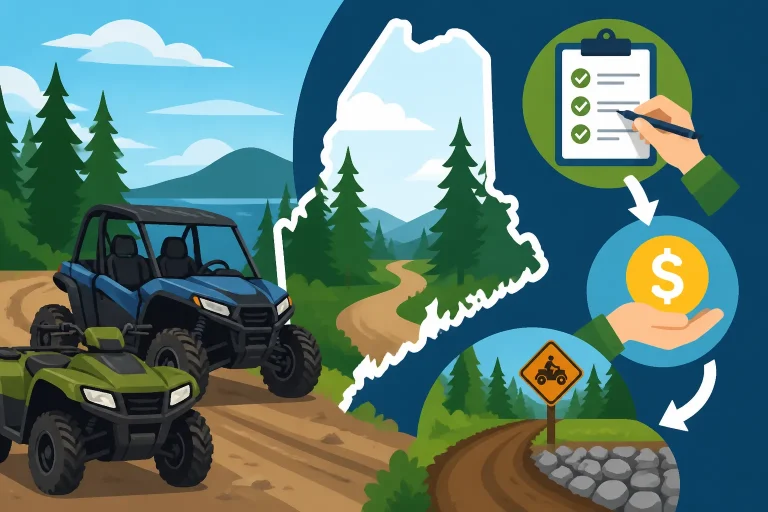
A safety certificate and permission to ride are not the same thing. Completing a course does not register an ATV, open a closed trail, grant access to private land, or make an otherwise restricted road legal to ride. Riders still need to understand What Maine Riders Need Before They Ride, including registration, trail access, and any age-specific operating rules.
| Your situation | Why an in-person course may help | What to confirm before enrolling |
|---|---|---|
| Rider is 10 to 15 | It may meet a youth safety-course requirement and provide supervised instruction | Minimum age, current requirement, and whether the course is approved |
| New adult rider | Offers a structured introduction to safe operation and trail decisions | Whether adults may enroll and whether a certificate is issued |
| Parent or supervising adult | Helps clarify supervision, equipment, and youth-riding expectations | Who must attend and what supervision rules apply |
| Rider has taken an online course | An in-person session may provide practical discussion or skills practice | Whether the online course already satisfies the rider’s requirement |
| Visiting rider from another state | Helps identify Maine-specific expectations before a trip | Whether an out-of-state certificate is accepted |
If a course is specifically intended for youth, review Maine ATV Safety Course for Riders 10 to 15. The exact eligibility and certificate requirements should be confirmed before you make plans, rather than inferred from a course description that might be old or incomplete.
An in-person course is not automatically the right choice for everyone. Some riders may be able to complete an approved online course, while others may benefit from having an instructor explain a topic or demonstrate a technique. Compare the options in Taking the Maine ATV Safety Course Online, and verify that the format you choose meets the requirement for the rider’s age and circumstances.
How to find and enroll in an in-person class
Course dates and locations can vary. Classes may be scheduled by approved instructors or local organizations, and availability may be seasonal. Don’t assume that a class held near you last year will be offered again, or that a listing on an unofficial calendar is current.
Use the official course information to locate an approved option. Where to Take a Maine ATV Safety Course can help you understand where to look. If a listing does not clearly identify the course as approved, ask the organizer before enrolling.
A straightforward enrollment process looks like this:
- Check the rider’s age and course requirement. Confirm whether the rider needs a course and whether the requirement applies to the planned riding activity. For youth, verify the current minimum age and any supervision conditions.
- Find an approved in-person class. Use official course listings or contact the listed organizer. Check the town, date, start time, and whether the class includes any practical portion.
- Ask about registration details. Confirm how to reserve a seat, whether a parent or guardian must register a minor, what identification or forms are needed, and whether the class has a limit on participants.
- Clarify the format and completion rules. Ask how long the session runs, whether students must attend the full class, and what they need to do to receive a certificate.
- Check for costs and required materials. Some classes may have costs or ask participants to bring supplies. The organizer can provide current details; do not rely on an old notice for amounts or requirements.
- Make a backup plan. If a class is canceled, full, or too far away, ask about the next in-person date or whether an approved online option is available.
When you contact an instructor, it helps to have a few specific questions ready:
- Is the course approved for Maine’s ATV safety requirement?
- Is this class open to the rider’s age group?
- Does it include hands-on instruction, or is it classroom-only?
- Does a parent or guardian need to stay for the session?
- What must a student complete to earn a certificate?
- How will the certificate be provided, and how should it be kept?
These questions can prevent a common mix-up: enrolling in an ATV-related event that offers helpful advice but does not count as an approved safety course. A club meeting, trail orientation, or rental briefing may be useful, but it should not be treated as a substitute unless the organizer confirms that it meets the official course requirement.
If the rider has completed training in another state, ask whether that certificate is accepted before signing up for another class. Requirements for out-of-state certificates can differ, and a course’s general reputation is not proof that it meets Maine’s rules. The page on Out-of-State Safety Certificates Accepted in Maine can help frame what to verify.
What to expect on course day
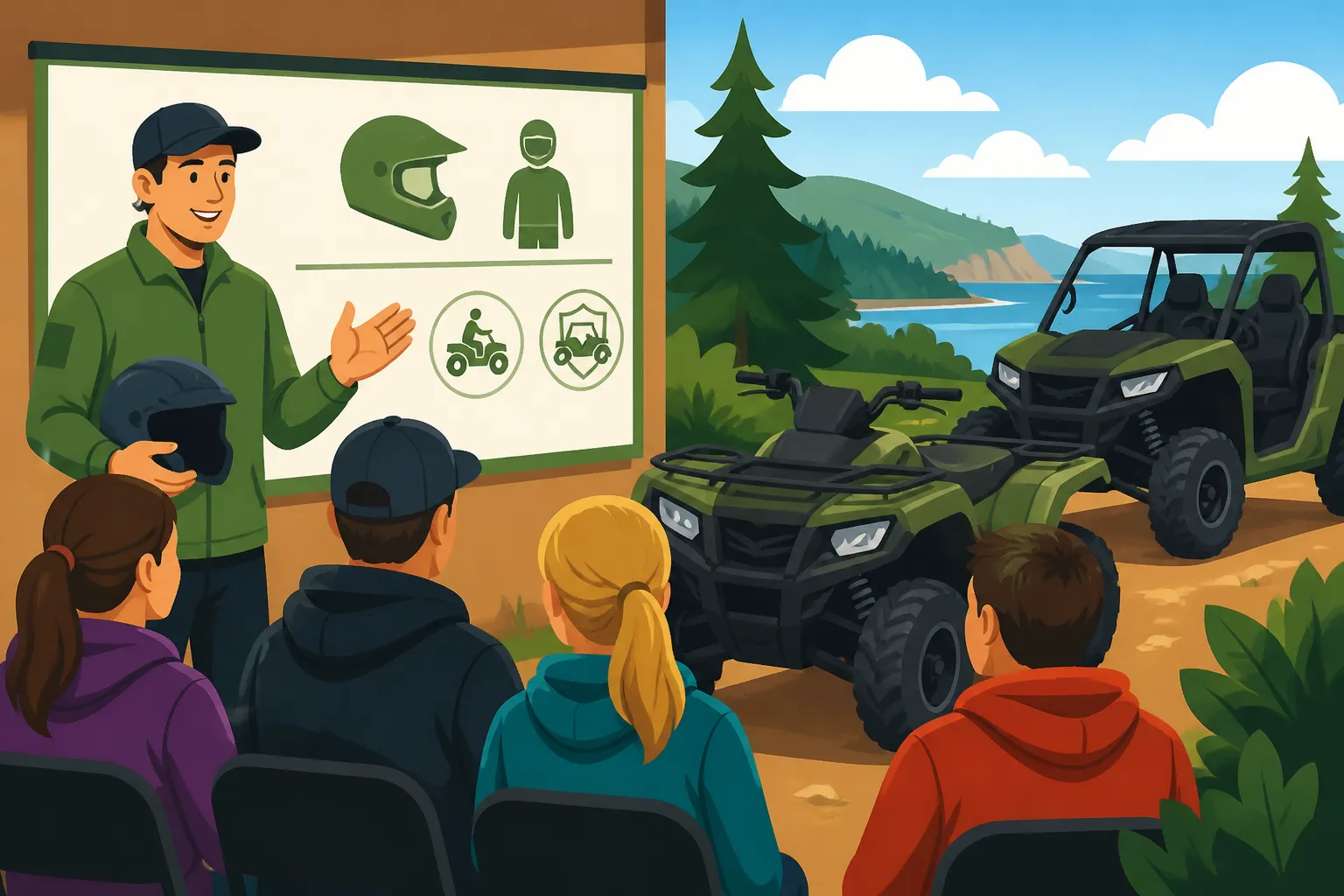
The exact format depends on the instructor and course. An in-person class may combine classroom instruction, discussion, demonstrations, and practical exercises. Confirm the schedule and format when enrolling. Some sessions may focus more heavily on classroom learning than riding practice, so do not assume that an ATV will be available for every student to operate.
Class topics commonly address the habits that help prevent avoidable crashes and trail conflicts: pre-ride checks, protective equipment, basic controls, terrain awareness, speed and stopping distance, carrying passengers, and riding with others. Instructors may also discuss what to do when a machine breaks down or a rider becomes separated from the group.
The value of attending in person is often the chance to ask questions about real situations. For example, a new rider might ask how to approach a narrow bridge, what to do when another group comes toward them, or why a machine that feels stable on flat ground can behave differently on a slope. An instructor can explain the principle and, if practical instruction is included, show how to apply it.
Before leaving home
Read the class instructions carefully. Bring only what the organizer requests, and contact the instructor if anything is unclear. Depending on the course, that may mean bringing identification, a registration confirmation, writing materials, or protective gear. Do not bring or operate a personal ATV unless the instructor specifically says to do so.
For a minor, confirm whether a parent or guardian must attend, sign paperwork, or remain on site. Arrive early enough to complete any check-in steps. If the course requires full attendance, plan transportation and timing so the rider can stay for the entire session.
During practical instruction
Follow the instructor’s directions rather than trying a maneuver independently. If there is an on-ATV component, the instructor should explain the equipment, boundaries, and safety procedures before practice begins. Tell the instructor if the rider is unfamiliar with the controls, has a concern about the machine, or needs an explanation repeated.
A practical exercise is not a test of bravery. The goal is to build sound habits, not to prove that a rider can go fast or handle difficult terrain. A student who is unsure should ask before proceeding. Parents can reinforce that a careful question is a sign of good judgment, not a failure.
Students should expect to learn principles that apply beyond the course area. A controlled exercise cannot reproduce every trail condition, machine, or group situation. New riders should keep practicing gradually and ride within their abilities after class.
If the class is canceled or the rider cannot finish
Ask the instructor how to handle a missed session, late arrival, or incomplete requirement. A student may need to attend another class or complete a required portion before receiving a certificate. Do not assume that partial attendance counts as course completion.
Weather, instructor availability, or a change in venue can affect an in-person class. Keep the organizer’s contact details and check messages before traveling. If an alternate date is offered, verify that it is still an approved course and that it fits the rider’s age and schedule.
After the course: certificates, registration, and safer riding
Once the rider completes the class, follow the instructor’s directions for receiving and keeping the certificate. Ask whether the certificate is issued at the end of the course or sent later, and keep a copy in a place where it can be found. If it is lost, the steps to replace it may depend on how the original course was recorded; Replacing a Lost Safety Certificate covers that issue.
Do not assume that the certificate expires or remains valid forever without checking. For the relevant rule and record-keeping advice, see Maine ATV Safety Certificate and Whether It Expires. If the rider’s age, home state, or riding plans change, confirm that the certificate still meets the applicable requirement.
The next step is to make sure the machine and ride are otherwise ready. A course certificate does not replace registration. Riders should check the registration requirements for the machine and use the correct route for registering or renewing it. Visitors should also confirm which registration applies to their trip; Maine ATV Registration for Non-Residents explains the non-resident issue.
Before riding, check the trail’s current status and confirm that access is allowed. Many routes depend on landowner permission and local conditions, and a trail can close even when it appears on a map. Review Landowner Permission on Maine ATV Trails and check current local information before setting out.
New riders should also match the ride to their ability. Start with a familiar, manageable route, ride with a responsible group, and leave enough time to return before dark. Check that the ATV is in sound operating condition and that the rider has appropriate protective equipment. Youth riders need supervision that meets Maine’s requirements, not simply an adult somewhere on the same trail.
A practical pre-ride checklist includes:
- Confirm the rider is old enough and has completed any required safety course.
- Check that the ATV is properly registered for the planned use.
- Verify trail access, closures, and any local restrictions.
- Wear appropriate protective gear, including a helmet where required.
- Inspect the controls, tires, lights, brakes, and fuel before departure.
- Agree on a route, pace, meeting points, and what to do if the group separates.
- Keep the first rides short enough to avoid fatigue or pressure to rush.
Course completion is a useful beginning, not a guarantee that every ride will be safe. Skills improve through careful practice, sound judgment, and respect for other riders and landowners. If a young rider is not ready for a particular machine or route, waiting is the safer decision.
Disclaimer
This article is for general informational purposes only and does not constitute professional advice. Laws, prices and regulations vary by location and change over time. Consult a qualified professional for guidance on your specific situation.