Maine ATV Rules During Firearm Deer Season
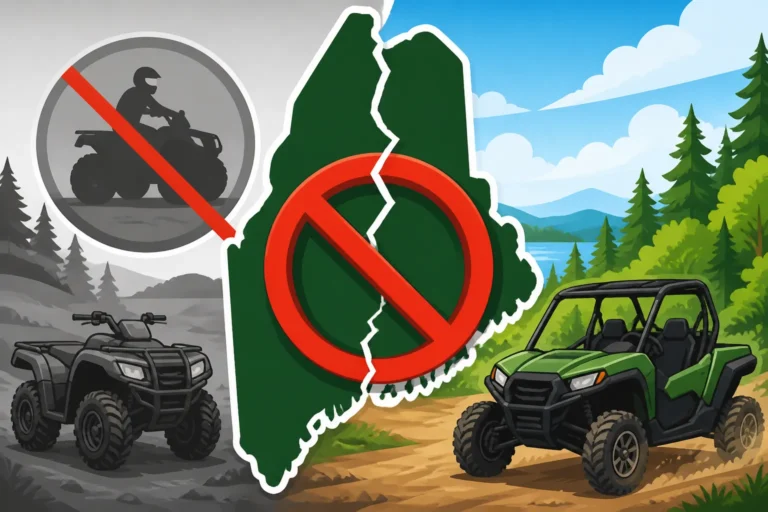
Maine ATV rules during firearm deer season affect more than the route to a hunting spot: firearm handling, land access, road crossings, and ordinary ATV requirements all matter. The key rule is simple but easy to overlook: an operator on an ATV must stop completely and turn off the engine before shooting. Here’s how to plan a ride without confusing trail access with permission to hunt or travel anywhere.
The firearm rules that apply when you’re on an ATV
According to the Maine Department of Inland Fisheries and Wildlife (MDIFW), a hunter on an ATV who is not inside an enclosed passenger compartment may shoot a firearm only when the ATV is completely stopped and its engine is turned off. MDIFW also says it is unlawful to carry a loaded firearm on or in an ATV while operating it.
Treat those as separate requirements. Stopping to shoot does not make it lawful to operate the machine with a loaded firearm on board. And turning off the engine is not optional when shooting from an ATV. If you’re unsure how to transport or handle a particular firearm, check the current Maine hunting regulations and firearm rules before the trip rather than relying on a general understanding of ATV rules.
These rules are especially important when a ride includes a hunting stop. Decide in advance where the machine will be parked, how the firearm will be handled, and how you will keep the firearm unloaded while the ATV is moving. If more than one person is involved, make sure everyone understands the plan before riding. A quick conversation at the trailhead can help prevent confusion later.
A UTV or side-by-side may have an enclosed passenger compartment, but that does not mean every ATV firearm rule automatically applies differently to every UTV. The stated rule distinguishes an ATV operator outside an enclosed passenger compartment; it does not settle every question about a particular machine or circumstance. If your vehicle has an enclosed cab, confirm how the rule applies to your vehicle with MDIFW before hunting from or transporting a firearm in it.
For more detail on the hunting context, see Maine ATV Rules for Hunting Access and Carrying a Firearm on an ATV in Maine. Those topics are worth reviewing before planning a route to a stand or camp.
Permission and trail access are separate questions
A trail that a rider can use is not automatically permission to hunt nearby, leave the trail, or cross adjoining land. According to MDIFW, eighty percent of the state-supported ATV trail system is located on private land. The Bureau of Parks and Lands also notes that most ATV trails in Maine are on private property and are maintained by local clubs.
That private-land reliance makes it important to stay on marked, open routes and respect the conditions set by landowners and trail managers. A marked trail is not a blanket invitation to ride off-route, park wherever convenient, or enter a field or woodlot for a hunting purpose. Check current trail information before you head out, and ask the landowner when permission is unclear.
The Office of the Revisor of Statutes, Maine Legislature, requires written landowner permission to use an ATV on cropland, pastureland, or in an orchard. That requirement is separate from any permission needed to hunt. If your route would cross or use one of those types of land, get the required written permission in advance; don’t assume that permission to hunt also covers ATV use.
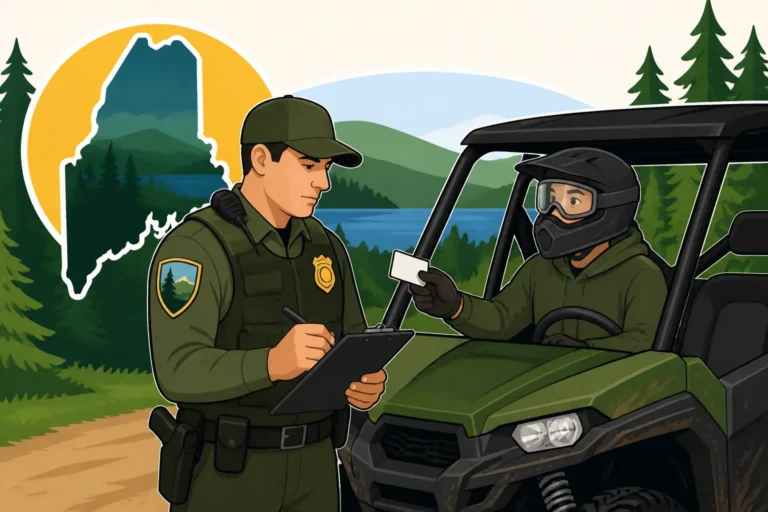
The Office of the Revisor of Statutes, Maine Legislature, also says that a person operating an ATV on another person’s land must stop and identify themselves when requested by the landowner or their representative. A calm, direct response is the practical choice: stop safely, identify yourself, and follow any lawful direction about access.
Before leaving, confirm whether the particular trail is open to ATVs. Interconnected Trail System routes are not necessarily open to ATV use; MDIFW says ITS trails that are open to ATVs will be posted with ATV trail markers. You can use Maine ATV Trail Maps and Club Boundaries to help with planning, but check current conditions too. Maps may not reflect a temporary closure or a landowner’s current access decision.
| Situation | What to check before riding |
|---|---|
| Riding a marked ATV trail | Confirm the trail is currently open to ATVs and follow posted markers and restrictions. |
| Leaving the trail to reach a hunting location | Confirm the landowner permits the off-trail travel and hunting access separately. |
| Crossing cropland, pastureland, or an orchard | Obtain the written permission required by the Office of the Revisor of Statutes, Maine Legislature. |
| Using another person’s land | Be ready to stop and identify yourself if the landowner or representative requests it, as required by the Office of the Revisor of Statutes, Maine Legislature. |
| Riding a public way | Follow the limited crossing rule and make a complete stop before entering, as required by the Office of the Revisor of Statutes, Maine Legislature. |
If your plan is to ride to a deer stand, don’t build the route around an assumption that the stand, a woods road, or a path beside a trail is open for ATV travel. Riding to a Deer Stand on an ATV and Maine ATV Rules on Posted Land can help clarify the separate access issues involved.
Registration, road crossings, and equipment still matter
Firearm season does not replace the normal rules for operating an ATV. Make sure the machine is registered as required for the ride, and bring the registration information you may need to show. MDIFW says ATV registrations expire on June 30. If you are uncertain about your machine’s status, resolve that before traveling rather than assuming an older sticker or paperwork is still valid. See When a Maine ATV Registration Expires for registration timing.
Riding on a public way is generally prohibited, with a limited exception for crossing. The Office of the Revisor of Statutes, Maine Legislature, allows a properly registered ATV to cross a public way for the necessary distance, not exceeding 500 yards. The same office requires riders to bring the ATV to a complete stop before entering a public way and to yield the right-of-way to other types of vehicular traffic while operating on a public way.
In practical terms, plan crossings at locations where you can see approaching traffic and enter safely. Do not treat the crossing exception as permission to ride along a road to reach another part of your hunting area. If you need help understanding how a particular road is designated or where an ATV route is allowed, check Maine ATV-Access Routes and How Towns Post Them.
Visibility deserves extra attention during early or late rides. The Office of the Revisor of Statutes, Maine Legislature, requires an ATV’s front headlight to cast a white beam at least 100 feet ahead and its rear taillight to display a red light visible at least 100 feet behind. The same office requires ATV lights to be used from half an hour after sunset to half an hour before sunrise, or when visibility is low. Check that both lights work before setting out, particularly if you expect to ride in dim conditions.
The Office of the Revisor of Statutes, Maine Legislature, also prohibits operating an ATV within 200 feet of specified buildings, including dwellings and churches, subject to certain exceptions. Do not assume that a trail or familiar route removes the need to account for nearby buildings and applicable exceptions.
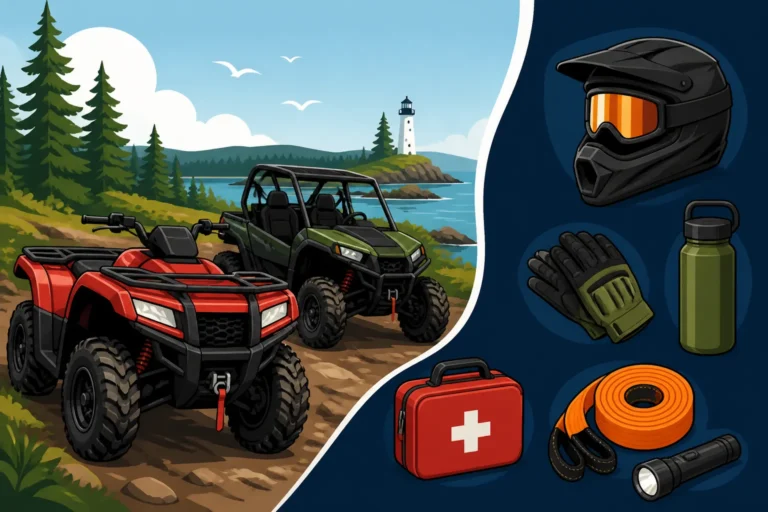
For younger riders, the rules are also important during a hunting-season trip. MDIFW requires youth ages 10 to under 16 to complete an approved safety course and be accompanied by an adult when operating an ATV. MDIFW also requires operators or passengers under 18 to wear protective headgear. Review Maine ATV Safety Course Requirements and Maine Helmet Requirements by Age if a young person will be riding.
A practical plan for a hunting-season ride
A little preparation can prevent the most common misunderstandings: thinking trail access includes hunting permission, treating a public way as a travel route, or overlooking the firearm rule while moving the machine.
Before the trip:
- Confirm the ATV is registered and that its registration is current.
- Check that the route is open to ATV use, including any trail sections that cross private land.
- Get permission for private-land access where needed, including written permission for ATV use on cropland, pastureland, or in an orchard.
- Decide where the ATV will be parked for a hunting stop and how the firearm will be handled safely and lawfully.
- Check the machine’s lights and other equipment, especially if the ride may extend into low visibility.
- Make sure every rider knows where the route crosses public ways and understands that a crossing is not permission to continue along the road.
When you’re underway:
- Stay on the marked, open route unless you have permission to go elsewhere.
- Stop and identify yourself if a landowner or representative requests it.
- Bring the ATV to a complete stop before entering a public way and yield to other traffic.
- Keep the firearm unloaded while operating the ATV, as required by MDIFW.
- If shooting while on an ATV and outside an enclosed passenger compartment, stop completely and turn off the engine first, as required by MDIFW.
- Avoid rushing when changing from riding to hunting. Park in a safe place, settle the machine, and make sure everyone understands what happens next.
These steps are not a substitute for checking the current hunting rules. Hunting requirements can apply independently of ATV operation, and a trail map alone cannot establish permission to hunt on the land beside a route. If a situation is unclear, confirm it with MDIFW or the relevant landowner before riding.
The basic approach is straightforward: follow an open trail, get permission for access beyond it, obey ordinary road-crossing requirements, and handle the firearm rule as a separate part of the ride. That keeps the trip grounded in both safe operation and respect for the landowners who make much of Maine’s trail access possible.
Sources
- Maine Dept of Inland Fisheries and Wildlife — All-Terrain Vehicles: ATV & Snowmobile: Maine Dept of Inland Fisheries and Wildlife (checked November 3, 2026)
- Maine Dept of Inland Fisheries and Wildlife — ATV Safety: Safety Courses: Educational Programs: Programs & Resources: Maine Dept of Inland Fisheries and Wildlife (checked November 3, 2026)
- Maine Dept of Inland Fisheries and Wildlife — ATV & Snowmobile Safety: ATV & Snowmobile: Maine Dept of Inland Fisheries and Wildlife (checked November 3, 2026)
- Office of the Revisor of Statutes, Maine Legislature — Title 12, §13157-A: Operation of ATVs (checked November 3, 2026)
- Maine Dept of Inland Fisheries and Wildlife — Laws & Rules: All-Terrain Vehicles: ATV & Snowmobile: Maine Dept of Inland Fisheries and Wildlife (checked November 3, 2026)
- Maine Department of Inland Fisheries and Wildlife — Laws & Rules: Snowmobiles: ATV & Snowmobile: Maine Dept of Inland Fisheries and Wildlife (checked November 3, 2026)
- Maine Department of Inland Fisheries & Wildlife — 25-MDIFW-22-ATV-SNOWMOBILE-2025-26.pdf (checked November 3, 2026)
- Maine Department of Inland Fisheries and Wildlife — 25-MDIFW-45-Snowmobile-standalone.pdf (checked November 3, 2026)
Disclaimer
This article is for general informational purposes only and does not constitute professional advice. Laws, prices and regulations vary by location and change over time. Consult a qualified professional for guidance on your specific situation.