Maine ATV Safety Certificate and Whether It Expires
A Maine ATV safety certificate generally does not expire, so a rider who completed an approved course usually does not need to retake it just because time has passed. The key is knowing whether the rider needs a certificate, whether an older or out-of-state record will be accepted, and what other rules still apply before riding.
Does a Maine ATV safety certificate expire?
In general, a Maine ATV safety certificate does not have a routine expiration date. Completing an approved course is not like renewing a registration or replacing an annual permit: riders generally do not need to repeat the course simply because their certificate is old.
That does not mean every old piece of paper will be easy to use as proof. A certificate may be faded, lost, or missing information, and an out-of-state course record may need to be checked before a rider relies on it. If the certificate was issued years ago, keep it available and ask the Maine Department of Inland Fisheries and Wildlife, often called Maine IF&W, how to confirm the record if needed.
It is also important to separate the certificate’s validity from the rider’s current legal requirements. A young person may have completed the course, but still need to follow age, supervision, helmet, registration, and access rules. A safety certificate confirms course completion; it does not grant permission to ride every machine, trail, road, or property.
| Question | Practical answer |
|---|---|
| Does a Maine ATV safety certificate normally expire? | No routine renewal is generally required after successful completion of an approved course. |
| Does an old certificate mean a rider can ignore current rules? | No. Age, supervision, registration, equipment, and land-access rules still apply. |
| What if the certificate is lost? | Ask Maine IF&W about confirming or replacing the record. |
| What if the course was completed outside Maine? | Check whether Maine accepts that course record before riding on the assumption that it qualifies. |
| Is a safety certificate the same as ATV registration? | No. They serve different purposes and prove different things. |
For an overview of who must complete training, see Maine ATV Safety Course Requirements. If the rider is a child or teenager, the age-specific rules are also worth checking in Maine ATV Safety Course for Riders 10 to 15.
Who needs a certificate, and what does it prove?
Maine’s safety-course rules are especially important for younger riders. In general, riders from 10 through 15 must complete an approved ATV safety course before operating an ATV. Age-related supervision and other restrictions may also apply. Because the details can depend on the rider’s age and circumstances, check the current requirements before a youth ride rather than relying only on a certificate.
The certificate proves that the person completed a qualifying safety course. It does not prove that:
- The ATV is registered.
- The rider has permission to use private land or a club trail.
- A trail is currently open.
- The rider is allowed to operate a particular machine under the rules for their age.
- The ATV can be operated on a public way.
- The rider has met any separate requirements for a road crossing or public-road use.
This distinction matters when a family has several machines or when a young rider is borrowing one. The certificate belongs to the person who took the course, not to the ATV. A parent’s certificate does not qualify a child, and one child’s certificate does not qualify a sibling.
A course certificate also is not the same as a driver’s license. ATV operation is subject to its own rules, including restrictions for young riders. Having a driver’s license does not automatically replace a required ATV safety course, and completing an ATV course does not grant permission to drive a car or operate an ATV wherever a vehicle may travel.
Certificate and supervision are separate requirements
A common mistake is treating the course as the only requirement for a young rider. Training and supervision are separate questions. A rider may have completed the course and still need an accompanying adult or other supervision, depending on the applicable rule and situation.
Before taking a youth rider out, confirm the requirements for that rider’s age, the machine, and where the ride will take place. The rules for a private property ride may not be identical to the rules that apply on a trail system or public way. Maine ATV Age Rules for Riders Under 16 and Adult Supervision Rules for Maine Youth Riders can help you check those parts of the picture.
The right question is not only “Does the child have a card?” It is also “Is this rider old enough to operate this machine here, and is the required adult supervision in place?” If any part of that answer is uncertain, pause and verify before riding.
Taking a course and keeping the certificate
A safety course is useful even when a rider is not required by age to take one. It can cover safe operation, riding judgment, common hazards, and responsibilities toward other trail users and landowners. The course format and availability can vary, so check the current options and eligibility details through Maine IF&W or another approved provider.
If you are arranging a course for a young rider, confirm that the specific course meets Maine’s requirements before enrolling. A general online ATV class or a course offered for a different state may not automatically satisfy Maine’s rules. Where to Take a Maine ATV Safety Course and Maine Safety Course Minimum Age are useful starting points when checking the options.
What to save after completing the course
After successful completion, save the certificate and any course-completion email or confirmation. Keep a clear image or scan in a safe place, but do not assume a phone copy will be accepted in every situation unless you have confirmed that. A paper copy can be a practical backup, especially for a youth rider whose completion may need to be verified.
It helps to check that the record includes the rider’s correct name and any other identifying details shown on the certificate. If the name is misspelled or the record does not appear to match the rider, contact the course provider or Maine IF&W rather than waiting until a trail stop or planned trip.
If a rider completes the course online, save the final completion page and any follow-up notice. A screen showing that someone started a course is not the same as proof that they passed or completed it. Keep the final confirmation, not just a registration email.
If the certificate is lost or damaged
A missing card does not necessarily mean the rider must take the entire course again. First, search for a digital record, course-provider email, or paper copy filed with other family documents. If the original course provider maintains records, ask whether it can confirm completion or issue a replacement. Maine IF&W can also explain the state’s process for checking or replacing a safety certificate record.
Avoid waiting until the day of a trip to solve a missing-certificate problem. Records may take time to locate, particularly if the course was taken through a provider that has changed its systems or contact details. For steps to take when the document cannot be found, see Replacing a Lost Safety Certificate.
Out-of-state certificates and older course records
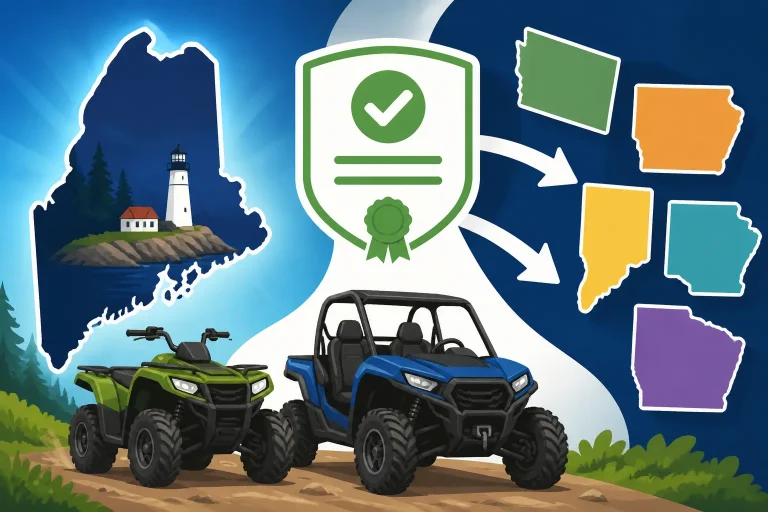
A rider who completed a course outside Maine should not assume that every certificate is automatically accepted. Maine may recognize qualifying out-of-state training, but the course and proof still need to meet the state’s requirements. Confirm acceptance with Maine IF&W before traveling, especially when a young rider’s ability to operate depends on having completed an approved course.
When asking whether an out-of-state certificate qualifies, have the document or course details ready. Useful information can include the rider’s name, the state where the course was taken, the provider, the completion date, and any certificate or record number. The answer may depend on the course’s approval and whether the record can be verified.
This is especially relevant for visitors. A rider may be registered in another state and still need to meet Maine’s safety, age, and trail-access requirements. Registration reciprocity and safety-course recognition are not the same issue. A registration accepted for use in Maine does not automatically settle whether a young rider’s course record qualifies. For related guidance, see Out-of-State Safety Certificates Accepted in Maine and Maine ATV Rules for Canadian Visitors.
Older records can raise similar questions. A certificate does not generally become invalid simply because it is old, but an incomplete or illegible document can make it hard to establish that the rider completed the right course. If the certificate lacks a clear name, provider, or completion detail, try to retrieve a record from the course provider or ask Maine IF&W what evidence it can accept.
If a young rider took a course under a different name, such as before a legal name change, keep documentation that helps connect the course record to the current identity. Do not alter the certificate yourself. Ask the issuer how to correct or document the record.
What to check before riding
A certificate is one item in a broader pre-ride check. For a youth rider in particular, confirm each requirement independently. That helps prevent a common mix-up: having proof of training but missing a required registration, permission, or supervision arrangement.
- Confirm the rider’s age and course status. Check whether the rider must have completed a course and whether the certificate on hand is verifiable. If the rider is 10 through 15, review the rules that apply to that age group.
- Confirm supervision. Check whether an adult must accompany or supervise the rider in the specific situation. Do not assume that course completion removes this requirement.
- Check the machine. Make sure it is appropriate for the rider and complies with applicable operating requirements. A safety certificate does not make an unsuitable machine suitable.
- Check registration. Confirm that the machine has the registration required for the planned use. Registration and safety training are separate. For the documents and requirements riders may need, see What Maine Riders Need Before They Ride.
- Confirm permission and trail status. A certificate does not authorize access to private land. Verify that the landowner or trail system allows the ride and that the route is open.
- Carry or store proof sensibly. Keep the certificate in a safe, accessible place and maintain a backup copy. Ask Maine IF&W what forms of proof are accepted if you do not have the original card.
- Review current rules before a trip. Rules can differ by age and location, and trail conditions or access can change. Check current guidance rather than relying on an old checklist alone.
If you are stopped during a ride, a safety certificate is only one possible document or fact that may come up. A warden or other official may also ask about registration, the rider’s age, permission, or the route being used. Maine Warden Checks and What They Ask explains why it is useful to keep the different requirements straight.
A good family practice is to keep a folder for each rider and a separate file for each machine. Put the rider’s certificate with the person’s records; keep registration and ownership papers with the machine’s records. That makes it easier to find the right proof without confusing a course card with a registration document.
Frequently Asked Questions
Can an ATV safety certificate expire if a rider gets older?
A Maine ATV safety certificate generally does not expire on a routine schedule. A rider’s age can change which operating rules apply, but it does not ordinarily cancel the course-completion record.
Does a parent’s certificate cover a child?
No. The certificate documents the completion of a course by the person named on it. Each rider who is required to complete training needs their own qualifying course record.
Does having a certificate mean a young rider can ride alone?
Not necessarily. Course completion and supervision are separate requirements. Check the rules for the rider’s age and the location where the ATV will be operated.
Can a rider use an out-of-state certificate in Maine?
Possibly, but confirm that the particular course and record meet Maine’s requirements. Do this before the trip if the rider’s eligibility depends on the certificate.
What should I do if I cannot find the certificate?
Look for a digital confirmation or contact the course provider to ask whether it can verify completion or issue a replacement. Maine IF&W can advise on the state’s process for checking the record.
Disclaimer
This article is for general informational purposes only and does not constitute professional advice. Laws, prices and regulations vary by location and change over time. Consult a qualified professional for guidance on your specific situation.