Out-of-State Safety Certificates Accepted in Maine
An ATV safety certificate from another state may satisfy Maine’s course requirement for a young rider, but not every card or online completion record automatically qualifies. The key is whether the course is officially recognized and whether you can show proof. Here’s how to check your certificate and what it does—and does not—allow you to do in Maine.
Does Maine accept an out-of-state ATV safety certificate?
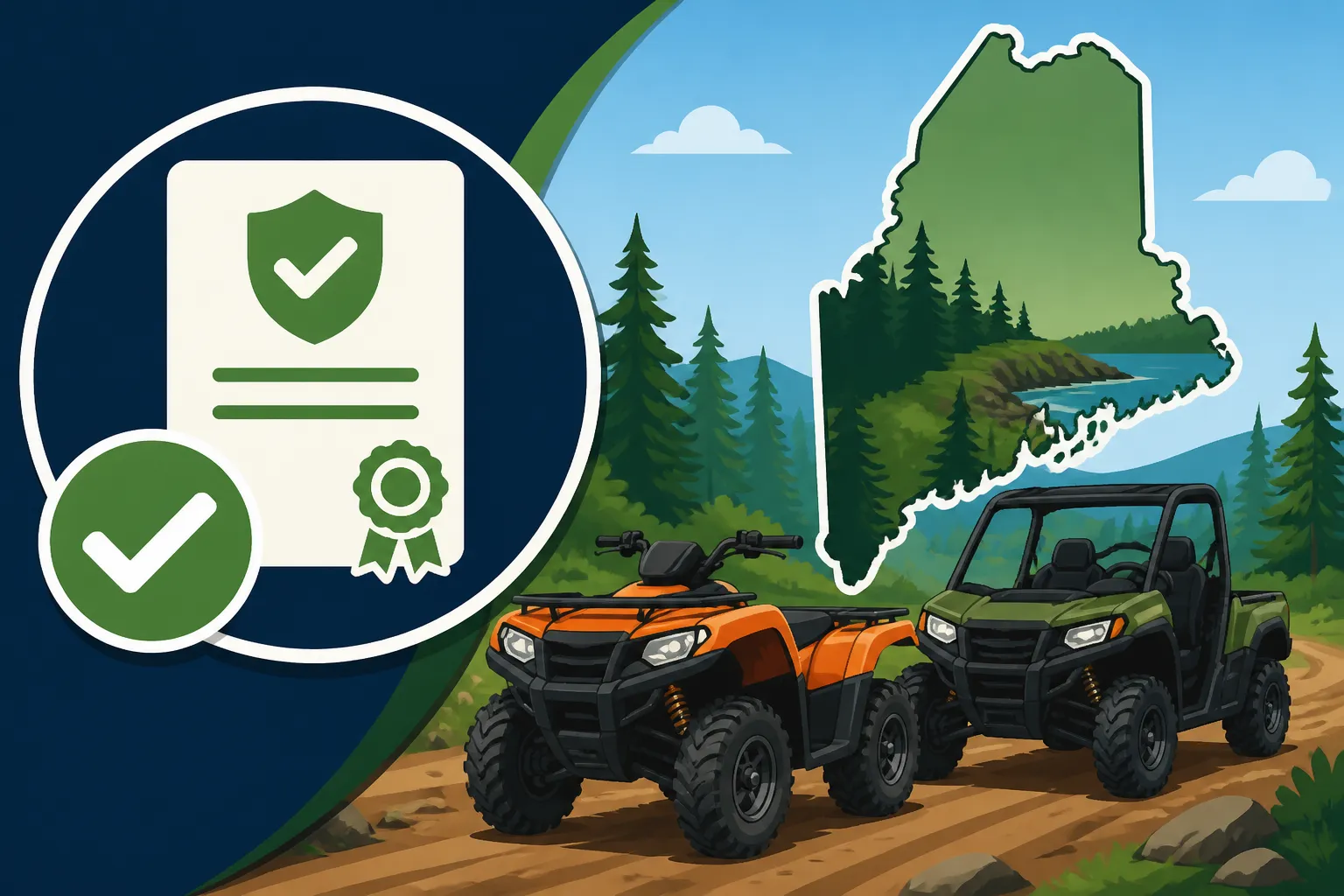
Maine generally recognizes a valid ATV safety certificate earned through an official safety course in another state. For a youth rider who must complete a safety course, an out-of-state certificate can be useful proof that the requirement has been met.
The important distinction is between an official course certificate and a record of informal training. A course provided or approved by a state agency or an authorized safety education program is more likely to be recognized than a generic online class, a retailer’s instructional session, or a parent’s statement that a child has learned to ride. If the certificate does not clearly identify the course, issuing organization, or student, confirm its status with the Maine Department of Inland Fisheries & Wildlife (MDIFW) before riding.
Maine’s youth safety course rules are most relevant to operators aged 10 to 15. If you are traveling with a young rider, check the age-specific requirements in Maine ATV Safety Course for Riders 10 to 15 and Maine ATV Rules for Riders Aged 10 to 15. A certificate does not waive other rules that apply to the rider, machine, or location.
If the certificate was issued in Canada or by a private provider, do not assume it will be treated the same way as a state-issued certificate from another U.S. jurisdiction. Course names and certification systems vary. Contact MDIFW with the issuer and course details if recognition is not clear.
How to check whether your certificate will work
Before your trip, look closely at the certificate and confirm that it shows who completed the course and who issued it. If you have only a temporary email or digital completion screen, save it somewhere you can access without cell service and ask whether it counts as proof.
These details can help you verify a certificate:
| Check | What to look for | Why it matters |
|---|---|---|
| Rider’s identity | The rider’s name matches their identification or other trip records | A certificate issued to a parent or sibling does not show that the operator completed the course |
| Course and subject | The record identifies ATV or all-terrain vehicle safety education | A motorcycle, boating, or snowmobile course is not automatically an ATV course |
| Issuing organization | A state agency or recognized safety education provider is named | A certificate from an unofficial course may not meet Maine’s requirement |
| Completion details | The record confirms successful completion, not just enrollment | A registration receipt or attendance note may not prove the course was passed |
| Certificate format | Keep the original card or a legible digital copy | You may need to show proof during a check or when resolving a question |
If information is missing, contact the course provider first. Ask whether it can issue a replacement or a more complete record. If you cannot establish the course’s status from the paperwork, contact MDIFW before the ride and provide the provider’s name, course title, and any certificate number.
Do not wait until you arrive at a trailhead to resolve uncertainty. Remote trail areas may have limited cell service, and a quick search on a phone may not be enough to establish that a course qualifies. Keep the response from the agency or provider with the certificate if the course is unusual or the documentation is incomplete.
A certificate is easiest to use when it is readable and available. Keep a paper copy with the rider’s trip documents, or save a clear image on a phone that will be carried on the ride. A small waterproof document sleeve, available from retailers such as Amazon, can help protect paper records from rain, mud, and storage wear. The sleeve is just a way to protect the document; it does not replace the certificate itself.
What the certificate does not replace
A safety certificate is evidence of course completion. It is not an ATV registration, trail permit, landowner permission, or general license to ride wherever you choose. Those requirements are separate, and a valid certificate does not make an otherwise unlawful ride permitted.
| Requirement | What it addresses | Does an out-of-state safety certificate replace it? |
|---|---|---|
| ATV safety course proof | Whether the rider completed required safety education | It may satisfy the course requirement if the course is recognized |
| Maine registration | Whether the machine is registered for use where registration is required | No |
| Trail or land access | Whether the rider may use a particular trail or property | No |
| Supervision rules | Whether a young rider must ride with an accompanying adult | No |
| Machine and riding rules | Requirements for the ATV, passengers, roads, and trail conduct | No |
If you are visiting from another state, check registration separately. Maine’s registration rules are not the same as the safety-course rules, and an out-of-state registration should not be treated as automatic permission to ride in Maine. The options for visitors are covered in Maine ATV Registration for Non-Residents. Canadian visitors should also review Maine ATV Rules for Canadian Visitors, since both registration and course documentation can raise separate questions.
Land access needs its own check, too. Maine trails often cross private land, and permission to use one route does not necessarily grant access to adjoining property or every connecting trail. Review Landowner Permission on Maine ATV Trails and confirm that your planned route is open before setting out.
A completed course also does not cancel age-related supervision requirements. If a young rider needs to be accompanied, carrying a certificate will not remove that obligation. Check Adult Supervision Rules for Maine Youth Riders and make sure the adult and rider understand the rules before they get on the machine.
A practical checklist before riding in Maine
A few checks before departure can prevent a certificate question from turning into a lost riding day.
- Check the rider’s age and the applicable course rule. If the operator is a youth, confirm whether Maine requires course completion for that rider. Start with Maine ATV Safety Course Requirements.
- Identify who issued the certificate. Look for the state agency or authorized provider, not just the name of a website or training company.
- Make sure the document proves completion. Confirm the rider’s name, ATV course subject, and completed status are visible.
- Ask about uncertain or non-U.S. certificates. Contact MDIFW before traveling if the provider or course is difficult to identify. Give the agency the course name and issuer rather than asking only whether “an out-of-state card” is accepted.
- Carry proof in a usable form. Keep the original card or a legible copy with the rider. Save a digital backup, but do not rely on being able to download it from an email or website in an area without service.
- Check the separate riding requirements. Confirm the machine’s registration status, trail access, supervision, and any local restrictions.
A simple way to avoid confusion is to keep the certificate with the rider’s other trip paperwork, while storing the machine’s registration separately. If more than one young rider is coming along, check each person’s document individually. One rider’s certificate cannot stand in for another’s.
If the certificate is lost, contact the issuing organization for a replacement before the trip. A screenshot of a course search page or a family member’s recollection of the training may not establish completion. If a replacement cannot be obtained in time, ask MDIFW what documentation it will accept rather than assuming a substitute is sufficient.
The main takeaway is straightforward: Maine may accept an out-of-state ATV safety certificate when it documents completion of an official, recognized ATV safety course. Verify any unusual certificate in advance, carry clear proof, and treat registration, access, and supervision as separate requirements.
Disclaimer
This article is for general informational purposes only and does not constitute professional advice. Laws, prices and regulations vary by location and change over time. Consult a qualified professional for guidance on your specific situation.